Rounding and heaping of height
Recorded height is a mixture of 5 rounding modes (tens, whole_cm, half_cm, round_up_from_x9, measured_0.1); the model gives the true value's distribution for each record.
| Date | 2026-10-13 |
| Status | current |
| Methods | Rounding, heaping and value resolution |
| Variables | Height |
Background
- Height is stored to 0.1 cm, so it looks measured. But some heights were written as whole centimetres, probably when the patient was not measured.
- It is the first variable whose resolution is mixed at the finest digit.
- Height changes by a centimetre or two over the day, which is handled separately as measurement variability.
Data
- 6,388 values, none missing or zero. One value is off the 0.1 cm grid (157.36).
- 57 cases are children (42 patients), down to 42 cm. They get native resolution only (flag
child_native_resolution). - Repeat cases copy the height: of 237 patients with more than one case, 158 have the same height every time.
- The fit uses adults, first case per patient (6,041). Later cases with the same height get the same posterior.
- Within each sex, height is close to normal (women 156.5 ± 6.1 cm, men 168.3 ± 6.4 cm).
Method
- Screened the last digit by emergency status, department, age, sex and calendar position.
- Latent: normal regression on sex and age (quadratic), with SD by sex.
- Candidate modes: whole cm, round tens, a half-centimetre mode, and a one-sided round-up from .9 with a ceiling anchor.
- Tested a rounding propensity that depends on emergency status, a first for the engine.
- Compared by BIC: no emergency effect, emergency on whole cm, plus the half-cm mode, plus round-up, and both.
- A 1 cm resolution override was fitted and then dropped (see discussion).
Results
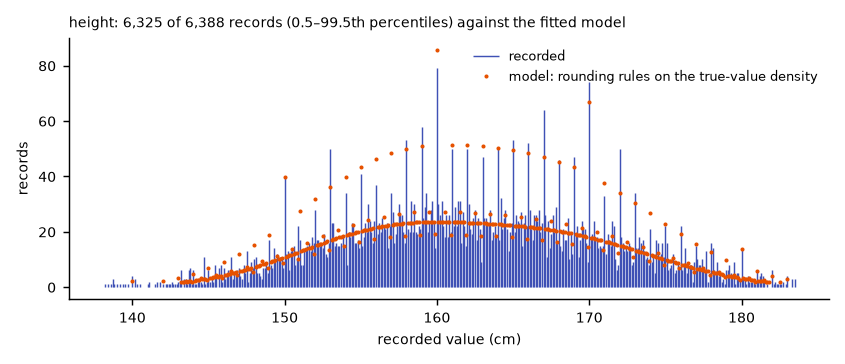
- After removing the 10% expected by chance, about 11% of elective and 21% of emergency heights were written as whole centimetres. Thoracic surgery is also higher (26% against 20% overall).
- The .9 digit is depleted (7.3% of elective heights, against about 9% for .1 to .4): a height just under a whole centimetre is often written as the centimetre above.
- There is a small excess at .5 (10.3%).
- Among whole-centimetre heights, 150, 160 and 170 are about 1.5 times their neighbours, but 155 and 165 are not.
- Each added component improved BIC: from 64,888 with no emergency effect to 64,852.5 with all of them.
- Emergency status on the 10 cm mode, department, and a heavy-tailed residual did not help.
- The engine reproduces the log-likelihood exactly (−32,378.3).
Discussion
- The 1 cm override worked as a fit, but it threw away the decimal digit, which is the best clue to whether a height was measured. The emergency effect vanished and the 160 heap could no longer be told apart from measured heights near 160.
- So the rounding model answers "what was written down?", and a separate measurement-variability field answers "how far is that from the patient's true height today?".
- The posterior weight of the non-measured modes is reported as
possibly_written_in. It is zero for any height whose last digit is not 0 or 5. - Measured heights get SD 0.5 cm (diurnal loss of about 14–17 mm plus stadiometer reproducibility; Leatt, Reilly & Troup 1986; Voss & Bailey 1997).
- Written-in heights are treated as self-reported, with bias by sex and age band from the 2018 Korea Community Health Survey (171,384 adults) and an SD of about 2.6 cm.
- The API needs sex, age and emergency status.
Limitations
- Measurement variability comes from the literature, not from this dataset, and is marked provisional.
- Children are not modelled.
Model
Model file: …/models/height.model.json. Read from the pinned snapshot of vitaldb-resolution at commit bb03ddfc8a (2026-10-18).
How a true value becomes the recorded one. The rules are tried in order: a record not taken by an earlier rule is taken by this one with the probability shown (where its condition holds); the last rule takes the rest. Shares of all records depend on the conditions and the true value, so the model must be evaluated for them; the probabilities below are the fitted ones.
| Order | Rule | Rounds to | Probability if reached | Applies when |
|---|---|---|---|---|
| 1 | tens | 10 cm (nearest) | 1.3 % | always |
| 2 | whole_cm | 1 cm (nearest) | 6.4 % | varies with emop |
| 3 | half_cm | 0.5 cm (nearest) | 3.0 % | always |
| 4 | round_up_from_x9 | 1 cm (ceiling) | 19.4 % | recorded minus true in [0.05, 0.15) |
| 5 | measured_0.1 | 0.1 cm (nearest) | the rest | always |
| Recorded resolution | 0.1 |
| True-value density | normal_regression |
| Covariates | sex, age, emop |
| Fitted on | 6,041 records (clinical_data.csv) |
| BIC | 64,852 |
| Fitted | 2026-10-13 |
- Rounding model kept at the native 0.1 cm so that the decimal digit can separate measured from written-in heights; diurnal height change is handled by measurement_variability, not by coarsening.
- Measurement variability (beyond rounding): SD 0.5 cm; for written-in values, SD 2.6 cm (from literature, not fitted).
Sources the model cites:
- Leatt P, Reilly T, Troup JG. Spinal loading during circuit weight-training and running. Br J Sports Med. 1986;20(3):119-124. doi:10.1136/bjsm.20.3.119
- Healey EL, Burden AM, McEwan IM, Fowler NE. Diurnal variation in stature: do those with chronic low-back pain differ from asymptomatic controls? Clin Biomech. 2011;26(4):331-336. doi:10.1016/j.clinbiomech.2010.11.017
- Voss LD, Bailey BJR. Diurnal variation in stature: is stretching the answer? Arch Dis Child. 1997;77(4):319-322. doi:10.1136/adc.77.4.319
- Ko Y, Choi S, Won J, Lee YK, Kim DH, Lee SK. Differences in accuracy of height, weight, and body mass index between self-reported and measured using the 2018 Korea Community Health Survey data. Epidemiol Health. 2022;44:e2022024. doi:10.4178/epih.e2022024
Code
References
- Leatt P, Reilly T, Troup JG. Spinal loading during circuit weight-training and running. Br J Sports Med. 1986;20(3):119-124. ↗
- Voss LD, Bailey BJR. Diurnal variation in stature: is stretching the answer? Arch Dis Child. 1997;77(4):319-322. ↗
- Healey EL, Burden AM, McEwan IM, Fowler NE. Diurnal variation in stature: do those with chronic low-back pain differ from asymptomatic controls? Clin Biomech. 2011;26(4):331-336. ↗
Tags: generated, vitaldb-resolution