Physical units, shared drift and time order
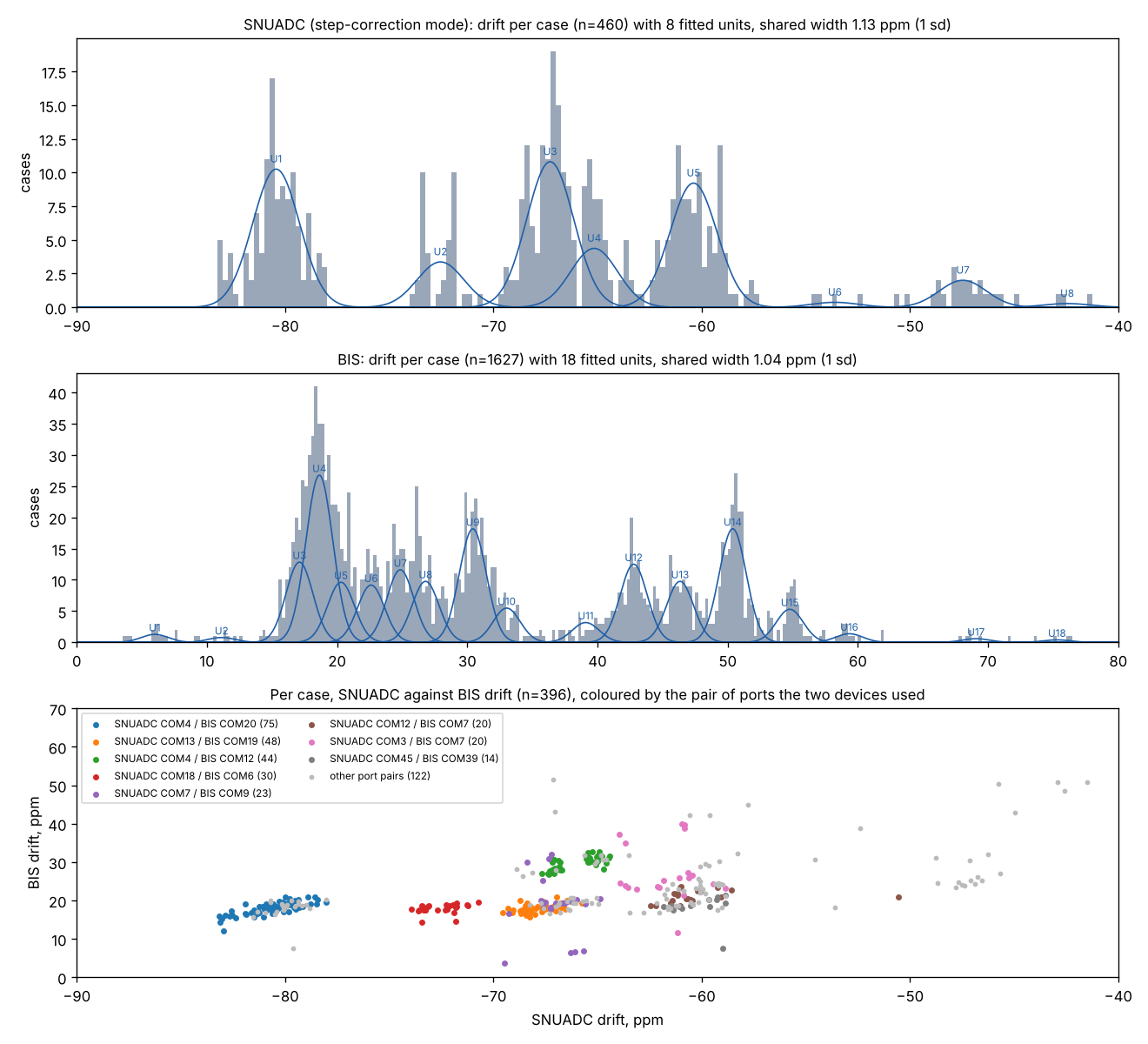
Device drift rates cluster into units: about 8 SNUADC boards and 8–18 BIS monitors. Part of the drift is shared by both devices of a case and changes between cases: the recorder PC's own rate. Case order carries no time information.
| Date | 2026-10-11 |
| Status | current |
| Methods | Reading the stamps |
| Techniques | Units from drift |
| Clocks | SNUADC sample clock, BIS clock, Recorder PC clock |
| Devices | SNUADC, BIS monitor, Vital Recorder |
Background
The release names a device by its model and gives no serial numbers, so which physical unit made a recording is unknown. A crystal's rate error is a fingerprint, stable to about a ppm, so units can be inferred from the rates. Each rate is measured against the PC, so the PC's own rate error adds to every device in a case.
Data
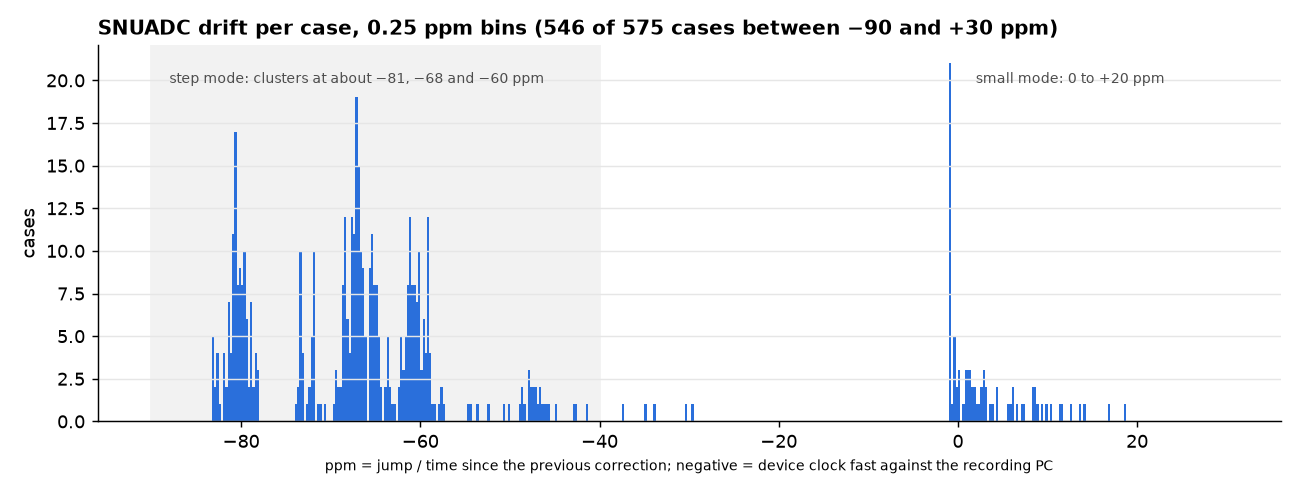
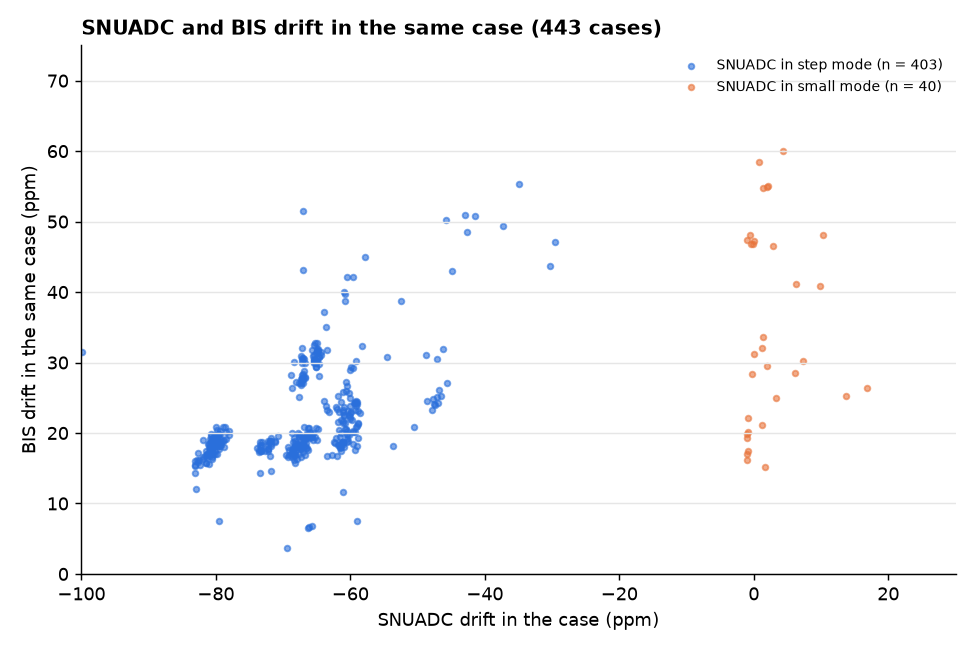
Per-case drift rates from Clock corrections in every file: 460 step-mode SNUADC cases, 1,627 BIS cases, 399 with both, with the serial port each device was attached to.
Method
Gaussian mixtures with one shared width per unit were fitted to the per-case rates, and a model-selection score (BIC) chose the number of units. Rates were grouped by serial port pairs. For setups with both devices, each rate was modelled as the device's own rate plus a term shared by both devices plus noise; a robust covariance (minimum covariance determinant) estimated the shared term. Neighbouring case ids were tested for similar drift.
Results
- SNUADC, step mode: 8 units of width 1.13 ppm, chiefly near −80.4, −72.5, −67.3, −65.2 and −60.4 ppm; 80% of cases are assigned with over 90% confidence.
- BIS: between 8 and 18 units of width about 1.0 ppm; only 40% of cases are confidently assigned.
- About 14 recording setups (pairs of ports) have at least 5 cases; within a port the spread is often only 1–2 ppm.
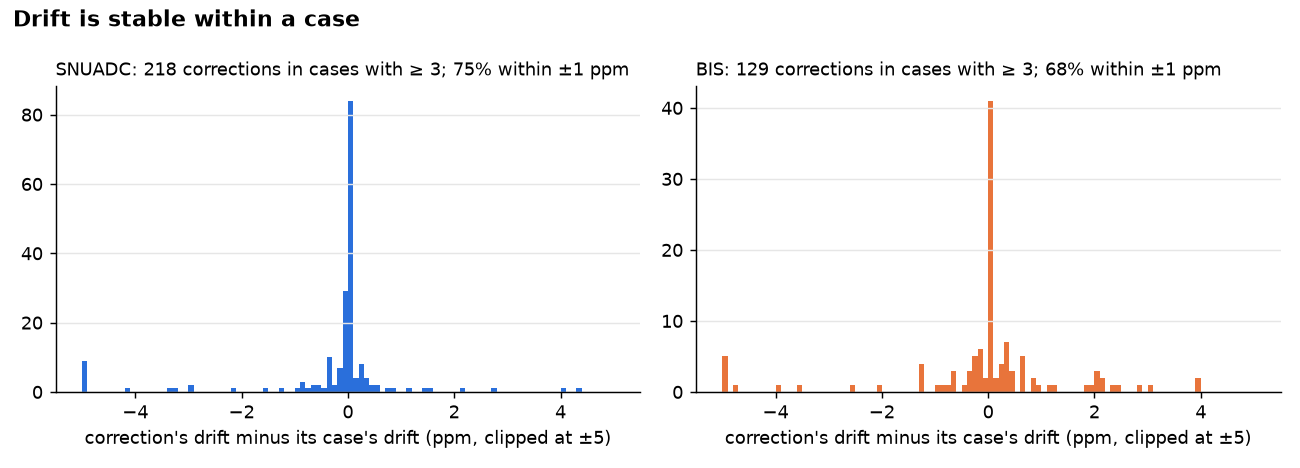
- Most of the spread within a setup is shared: 0.6–1.3 ppm (SD), against under 0.6 ppm for each SNUADC alone and 0.3–1.3 ppm for each BIS. The shared term is fixed within a case (interval-to-interval changes of the two devices are uncorrelated, r = 0.02).
- No time order. Case ids are not chronological: neighbours are no more alike in drift than random pairs. The SNUADC frequent-correction mode is confined to a few setups, can switch either way within a case, and marks a period in at most one setup.
Discussion
The shared term is most likely the PC's rate, differing between days rather than wandering during surgery. The difference of two devices' rates cancels it and is the better fingerprint of a device pair.
Observations it supports
| Observation | Status | Summary |
|---|---|---|
| Case ids carry no time order | established | Dates are shifted and case ids are shuffled: neighbouring ids are no more alike in device drift or port than random pairs. |
| Device clock drift depends on the setup | established | The drift of the SNUADC's and the BIS's timestamps against the recorder PC is largely set by the setup: knowing a recording's PC key (the serial ports of its four core devices) puts the SNUADC's drift within 3 ppm of its setup's median in 97% of cases and the BIS's in 83%, against 34% and 17% for the release's median. On the whole release's correction intervals the same test gives 71% and 60% (Identifying the recording setup of every case). |
| The SNUADC correction mode belongs to setups, not dates | established | The frequent-correction mode is confined to a few setups, can switch either way within a case, and marks a period in at most one setup. It is not a global software change. |
| Long SNUADC recordings with no correction at all | open | 1,066 cases of 2.5 h or longer show no SNUADC correction, although at the step-mode median of −63 ppm a 0.49 s step falls due within about 2.2 h. Slower units, a third recorder mode, or both; shared bursts point to slower units (about −36 ppm where the BIS rate is known, The stamp sawtooth model for SNUADC and BIS, due only after about 3.8 h). The Solar8000 route cannot settle it: its rates shrink toward zero in recordings under about 4 h (The SNUADC clock through the Solar8000 numerics, whole release). |
Limitations
Units are inferred, not known; busy ports carried several units.
Open questions
- Which unit is which device (unexplained phenomenon). Units are inferred from drift alone, and busy ports carried several units. The physical boards behind each unit are not identified.
- Per-setup drift in the uncertainty models (next step). Drift is known per setup far better than over the release (Device clock drift depends on the setup). The drift parameters now list per-setup values (by PC key), but the clock domains and the planner still use one value for all recordings. They should take a recording's setup when its ports are known, with the release range only as the fallback. The per-setup values come from the correction scan's cases; the whole-release correction steps (When each device's clock is corrected, in every recording) would give them for three to five times as many.
Code
Figures