The charted anesthesia end time is a mixture of 4 ways of writing a clock time (ceiling_30min, ceiling_10min, ceiling_5min, clock_minute), modelled as an offset from a device time.
Anaesthesia ends from clinical_data.csv, modelled against the recording end.
Excluded: the anaesthesia ends derived from an imputed op end (stored with floating-point noise), the 1900 placeholder in case 4476, and two values outside the model range, case 3980 (+720 min, probably a 12-hour clock error) and case 4959 (+1,441 min, probably a date error).
2,037 anaesthesia ends (32%) fall after the end of recording. This is plausible, since monitors come off before handover, but these cannot be checked against the signals.
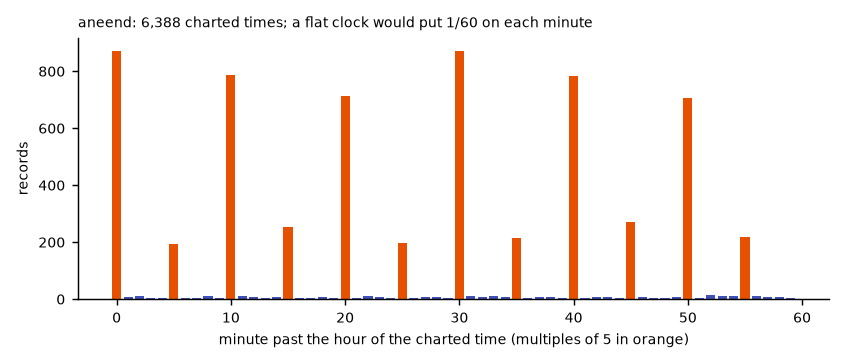
The minute past the hour of every charted time: the heaps on multiples of 5, and at the standard first-case times, are the rounding modes the model fits.
Minutes :00, :10, :20, :30, :40 and :50 have 706–872 cases each, against 192–271 at the 5s. :00 and :30 are slightly higher (872 each).
Rounded ends are written up to the next mark: ceiling beats nearest by 168 BIC points and floor by 782. An end charted as 11:30 means "finished by 11:30".
Hour, emergency status and department made no difference.
On average the true end is about 4 min before the charted end, so anaesthesia durations computed from charted times run long by a few minutes.
Since vitaldb-resolution v0.6.0 (18 October; model version 2): the two out-of-range records are excluded
(not corrected), and the stored and recomputed log-likelihoods now agree: the whole gap came from those two
records. The parameters are unchanged.
Ceiling rounding for anaesthesia end and floor rounding for op end together inflate charted emergence by about 6–7 min.
Correction: an earlier fit did not exclude the derived ends, because their noise (about 10⁻⁶ s) slipped under the test threshold. The model was refitted without them and with a wider offset range; the conclusions are unchanged.
Before v0.6.0 the package's log-likelihood differed from the stored one by +1,381.5: the two out-of-range records had been left in the fit at probability 10⁻³⁰⁰ (−690.8 each). They are constants, so the parameters were unaffected; model version 2 excludes them and the two now agree.
An anaesthesia start or end entered on a 5-minute mark was rounded up to it: the event happened in the 5 minutes before, and on average a little earlier still. Clear for anaesthesia end; for anaesthesia start the margin is small, and the value model (How the anesthesia start time was charted) prefers rounding to the nearest mark.
Two out-of-range end times as 12-hour or date errors(weakly supported hypothesis). Two anaesthesia-end records lie at 720 and 1,441 minutes, outside the modelled range. A 12-hour clock slip and a one-day date error are the obvious explanations; neither is confirmed.
How a true value becomes the recorded one. The rules are tried in order: a record not taken by an earlier rule is taken by this one with the probability shown (where its condition holds); the last rule takes the rest. With no conditions, the shares follow directly.
Acute kidney injury after surgery against intraoperative urine output (mL/kg/h), fitted once on the recorded numbers and once per draw from the true-value distributions: the rounding moves 14% of cases across the oliguria threshold, but widens the confidence interval of the cohort's regression by at most 4%.
One label per patient, oliguric or not, from three rounded numbers: 10% of labels are uncertain and 2.6% are expected to be wrong, which sets a floor under the error any model can be measured to have. A typical model is barely affected; a good one is.
Intraoperative urine output per kilogram per hour, from three rounded inputs, as a probability distribution per case: one case in ten cannot be placed confidently on either side of 0.5 mL/kg/h.