The Primus AWP stops for about 21 s every 7,230 s
In 5,502 recordings the Primus airway-pressure waveform has gaps of 19–23.5 s (whole messages of 0.48 s, mostly 21.12 s) that recur every 7,230 s, the Primus's correction interval; a clock correction follows about 21.6 s after. The CO₂ waveform carries on through 90% of them. The 21 s of AWP are lost, not merely re-stamped.
| Status | established: shown on many cases, with a control. |
| Clocks | Primus clock |
| Devices | Primus anaesthesia machine |
| Variables | Airway pressure (Primus), Capnogram (Primus) |
What it means
An AWP gap of about 21 s is the Primus's two-hourly resynchronisation: about 21 s of airway pressure is never recorded. It is not a disconnection, and CO₂ covers the same breaths. Within the Primus nothing needs re-timing (AWP keeps its lag to CO₂), but against the recorder PC the stamps step at the pause: a median −1 ms (p10–p90 −164 to +187 ms) at the 74% of pauses where CO₂ carries on, and by up to seconds at the 26% where CO₂ stops too (The Primus stamp step at each airway-pressure pause), so a Primus–SNUADC offset fitted before a pause does not carry over to after it.
What is done about it
Treat it as a real gap. Flagged as a periodic device event in the step classes.
Detail
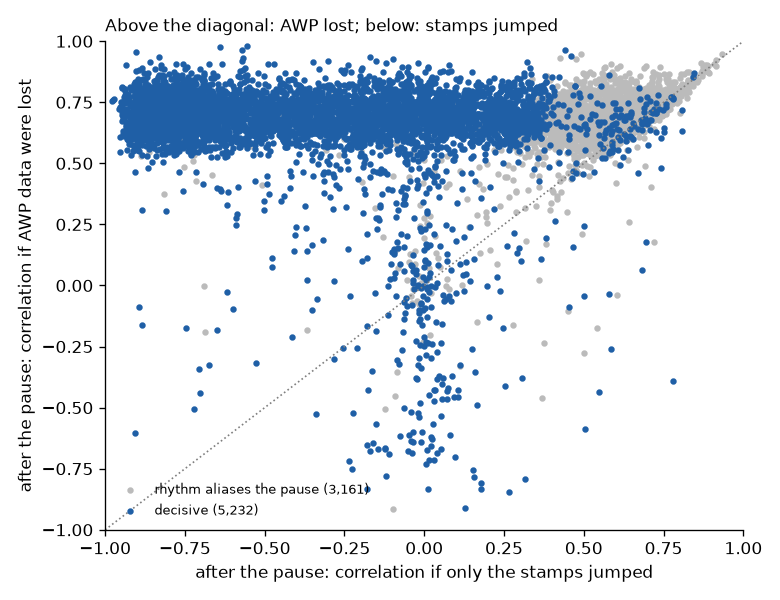
Lost, not re-stamped. CO₂ and AWP come from the same device and the same breaths, so their breathing patterns line up at a small, fixed lag. For each pause, that lag was measured in the 2 minutes before it (median 1 s), and the correlation in the 2 minutes after it was compared at the same lag (as if AWP data were lost and the stamps are right) and at the same lag plus the pause length (as if no data were lost and only the stamps jumped). In 9,122 pauses with data on both sides, 8,393 had AWP and CO₂ correlated before the pause; in the 5,232 (3,552 recordings) whose breathing rhythm does not make the two answers look alike, 96% fit lost data (median correlation 0.69 against −0.35).
Evidence
| Study | Date | Status | Summary |
|---|---|---|---|
| When each device's clock is corrected, in every recording | 2026-10-19 | draft | From the steps between records in all 6,388 recordings: the BIS is corrected every 8,192 s and the Primus every 7,230 s, on their own timers (the first correction comes at any time after the device starts); the SNUADC is reset when 0.49 s of drift has built up. With the full rerun of the correction fit, it gives each device's drift against the recorder PC in 4,728 BIS and 2,728 SNUADC recordings, and shows that the Primus's 20–23 s AWP pauses belong to its correction cycle. Every rate here is relative to the recorder PC, whose own clock drifts and is corrected. |
| What each break in the stamps is | 2026-10-19 | draft | Every step between waveform records in the release, sorted by mechanism: written twice, a SNUADC clock reset, interleaved streams, a pause shared by every device, whole messages, less than a message, or a fraction of a message beyond whole ones. A continuity test with controls shows which classes lose data: shared pauses and most longer SNUADC gaps do; steps under one message, and SNUADC's lone one-message steps, mostly do not. |
| The Primus stamp step at each airway-pressure pause | 2026-10-19 | current | Measured directly at 2,491 pauses in 1,021 recordings: where CO₂ carries on through the AWP pause (74%), the Primus stamps barely step (median −1 ms, p10–p90 −164 to +187 ms, close to the no-pause controls); where CO₂ stops too (26%), they step by up to seconds. No step undoes the drift built up since the last pause. |