Draft
Not yet written up in full.
When each device's clock is corrected, in every recording
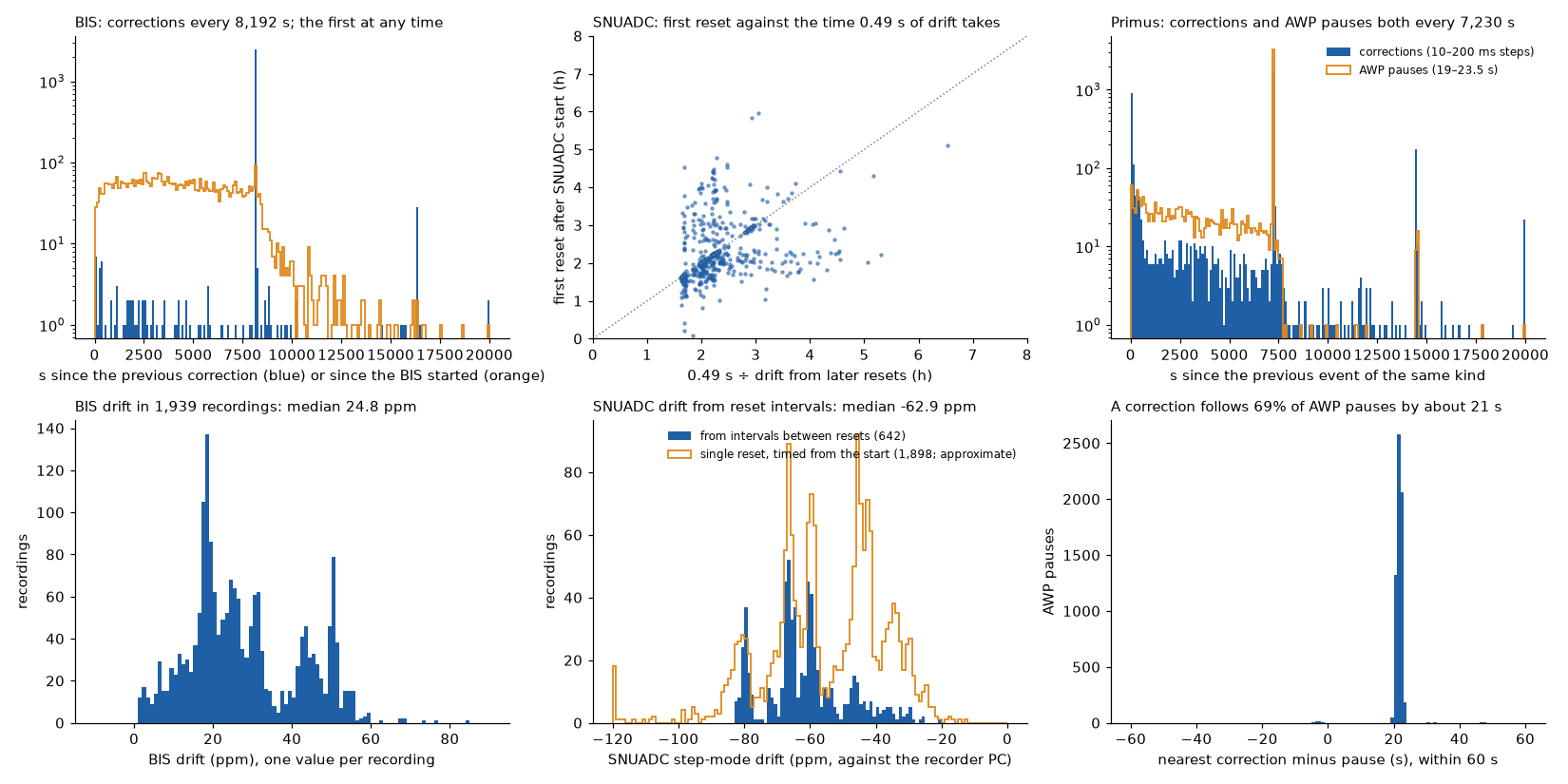
From the steps between records in all 6,388 recordings: the BIS is corrected every 8,192 s and the Primus every 7,230 s, on their own timers (the first correction comes at any time after the device starts); the SNUADC is reset when 0.49 s of drift has built up. With the full rerun of the correction fit, it gives each device's drift against the recorder PC in 4,728 BIS and 2,728 SNUADC recordings, and shows that the Primus's 20–23 s AWP pauses belong to its correction cycle. Every rate here is relative to the recorder PC, whose own clock drifts and is corrected.
| Date | 2026-10-19 |
| Status | draft |
| Methods | Data continuity, Reading the stamps |
| Techniques | Remainder test |
| Clocks | BIS clock, SNUADC sample clock, Primus clock, Recorder PC clock |
| Devices | BIS monitor, SNUADC, Primus anaesthesia machine |
| Variables | BIS EEG, ECG lead II (SNUADC), Airway pressure (Primus), Capnogram (Primus) |
Background
Every rate here is relative. Each record is stamped by the recorder PC, so a device's "drift" is its own clock against the PC's clock (Recorder PC clock), not against true time. The PC clock itself drifts and is corrected by its time service (Recorder PC against UTC); a PC correction inside a measurement interval shifts that interval's apparent device drift, so part of the spread below may be the PC's, not the device's.
Earlier studies measured the correction schedules on a few hundred benchmark recordings (How often each device is corrected, The stamp sawtooth model for SNUADC and BIS). The step tables already hold every correction in the release, so the schedules, and the drift they imply, can be read for every recording.
Data
The classified steps between records of What each break in the stamps is (all 6,388 recordings) and the start of each track from the segment tables of Gaps and unbroken segments in every waveform; for comparison, the per-recording drift rates of Clock corrections in every file (BIS 1,627, SNUADC 460 recordings).
Method
- Census:
tools/clock_correction_periods.pyrerun on all 6,388 recordings (19 October, WSL): the stamp-clock fit of each SNUADC and BIS track, giving a drift for every recording with at least one correction. - BIS: a correction is a forward step of 10 ms to 1 s in the EEG track that no other device shares. The drift is the step divided by the time since the previous correction, for corrections 8,192 ± 20 s apart.
- SNUADC: a reset is a run of backward steps summing to −0.45 to −0.52 s (What each break in the stamps is). The drift is its size divided by the time since the previous reset. For the first reset, size divided by the time since the SNUADC track started gives an approximate value. Six recordings with −0.5 s steps throughout are left out.
- Primus: corrections are AWP steps of 10 to 200 ms in either direction; pauses are AWP forward steps of 19 to 23.5 s that no other device shares.
Results
- BIS: every 8,192 s, on the BIS's own timer. 95% of corrections after the first come 8,192 ± 20 s after the previous one; the first comes at any time after the BIS starts (uniform over 0–8,192 s), so the timer does not start with the recording. The median correction is 0.17 s. BIS drift against the recorder PC, in the 1,939 recordings with two corrections or more: median 24.8 ppm (5th–95th percentile 7.3–51.1), in several clusters (about 18, 28, 44 and 50 ppm), which Device clock drift depends on the setup ties to setups. The census fit gives it in all 4,728 BIS recordings with a correction (median 21.1 ppm, 5th–95th 2.1–52.8) and agrees with the intervals where both exist (median difference 0.00 ppm; 33% differ by more than 1 ppm).
- SNUADC: reset when 0.49 s of drift has built up. 3,417 resets in 2,540 recordings: 2,411 as five records out of order (Five records out of order at every SNUADC reset), 991 as one step. Between resets, a median 2.08 h (5th–95th percentile 1.65–3.57). Drift in the 642 recordings with two resets or more: median −62.9 ppm (5th–95th −80.3 to −36.9) against the recorder PC, again in clusters, and the same within 0.01 ppm from the census fit. The census gives it in all 2,728 SNUADC recordings with a correction (median −49.5 ppm, 5th–95th −79.1 to −8.1). The earlier per-recording drift (Clock corrections in every file) differs by 0.95 ppm in every one of 418 recordings: the stamp arithmetic (SNUADC stamps run −0.95 ppm against the sample count), which that fit included.
- The SNUADC count usually starts with the recording, but not reliably enough to time drift from it. The first reset comes at 0.99 × (0.49 s ÷ drift) after the SNUADC starts in the median recording (interquartile range 0.87–1.01), with wide tails (5th–95th 0.56–1.75). Drift timed that way in the 1,898 single-reset recordings is about 10 ppm off the census fit (median difference −9.8 ppm, interquartile −20 to −5), so it is not used.
- Drift varies within a recording more than quantisation allows. Between consecutive intervals of the same recording, BIS drift varies by a median 3.5 ppm (standard deviation; quarter of recordings above 8.6) and SNUADC by 1.2 ppm (above 12.7 in a quarter), against about 1.0 and 0.3 ppm from the stamp resolution. Some of this may be the recorder PC's own corrections.
- But the BIS and SNUADC swings move in opposite directions. In the 133 recordings with at least two intervals of each device, each SNUADC interval's deviation from the recording's mean drift correlates with the time-matched BIS deviation at r = −0.54 (288 intervals; with BIS intervals shuffled within each recording, −0.01, 95% range −0.22 to 0.18). Both drifts are defined the same way (how much the PC's clock gains on the device's), so a PC clock that ran fast for a while would raise both: a positive correlation. The negative one points instead to something acting on the two oscillators in opposite directions (temperature acts on crystals of different cuts with opposite signs), or to a coupling in how they are measured that is not yet found. Within a recording the SNUADC drift swings more than the BIS drift (standard deviation 8.9 against 2.6 ppm).
- Primus: every 7,230 s, also on its own timer, and the AWP pauses belong to the cycle. 8,077 corrections in 4,529 recordings, each a whole number of 16 ms samples (one sample at 62.5 Hz) in either direction, often two at once (median −16 ms; p10–p90 −144 to +144 ms); 7,230 s apart, or twice that. These steps are far too small for the Primus drift, which breath matching measures at +104 ppm against the PC (Primus drift against the recorder PC, from breath matching), so they do not give its rate. The 10,496 AWP pauses of 19–23.5 s in 5,502 recordings recur at the same interval, and where a correction lies within 60 s (69% of pauses) it follows the pause by about 21.6 s. The CO₂ track has no gap at the same moment in 90% of them, and the AWP data in the pause are lost, not re-stamped: after each pause AWP still lines up with CO₂ at the lag it had before (The Primus AWP stops for about 21 s every 7,230 s).
- These cycles end the long segments: the BIS segments that pile up at 7,500–8,500 s and the Primus AWP segments that never exceed about 7,980 s (Gaps and unbroken segments in every waveform) are cut by the corrections and pauses.
| Parameter | Value | Status | From |
|---|---|---|---|
| BIS correction interval | 8,192 s (2 h 16.5 min), ± 20 s in 95% of intervals | measured | When each device's clock is corrected, in every recording |
| BIS correction size | 0.17 s median | measured | When each device's clock is corrected, in every recording |
| Primus correction interval | about 7,230 s (2.0 h; p90 twice that) | measured | When each device's clock is corrected, in every recording |
| Primus correction size | whole 16 ms samples either way; median −16 ms (one sample back), p10–p90 −144 to +144 ms | measured | When each device's clock is corrected, in every recording |
Discussion
The schedules give drift where earlier studies needed a fit, for three to five times as many recordings, and they are consistent with those fits. The BIS and Primus timers run independently of the recording, so a recording shorter than one cycle carries no correction of that device; their drift there has to come from the setup (Identifying the recording setup of every case). The SNUADC's threshold behaviour means its first reset also carries drift information, though less reliably than an interval.
Observations it supports
| Observation | Status | Summary |
|---|---|---|
| The Primus AWP stops for about 21 s every 7,230 s | established | In 5,502 recordings the Primus airway-pressure waveform has gaps of 19–23.5 s (whole messages of 0.48 s, mostly 21.12 s) that recur every 7,230 s, the Primus's correction interval; a clock correction follows about 21.6 s after. The CO₂ waveform carries on through 90% of them. The 21 s of AWP are lost, not merely re-stamped. |
Limitations
- Corrections inside a gap or shared with another device's step are not counted; a drift is measured only where two corrections bound an interval.
- Backward steps were capped at 3,000 per track in the step scan; the few recordings with more lose some resets.
- All rates are against the recorder PC; none is traceable to UTC (Recorder PC against UTC is assumed).
Open questions
- Why does the SNUADC appear to speed up when the BIS slows down? (weakly supported hypothesis). Within a recording, the SNUADC and BIS drift deviations against the recorder PC are anticorrelated (r = −0.54, 133 recordings; shuffled null −0.01), the opposite of what a shared PC excursion would give. Candidates: a common factor acting on the two oscillators with opposite signs (temperature, on crystals of different cuts), or a coupling in how the two drifts are measured. Test against each recording's time course (temperature itself is not recorded; operating-room events and recording length are proxies) and in the joint clock model.
- How much of the drift spread is the recorder PC's? (next step). A joint model of the PC and every device clock (each drifting and corrected), fitted to all correction events at once, would separate the PC's corrections from the devices'; events seen by several devices at once (diathermy bursts, Shared bursts between the ECG and the EEG) would validate it.
Worked examples
| Example | Side | Status | Summary |
|---|---|---|---|
| Pulse pressure variation gated by ventilator breaths | time | draft | Pulse pressure variation per ventilator breath, in 3,448 recordings: the ventilator's clock sits a median 1.8 s off the arterial line's, which moves half of all breaths' values by a point or more and scatters where in the breath the pulse pressure peaks; a recording's median PPV hardly changes. |