Open
Work in progress: results may change.
Identifying the recording setup of every case
Recognising which equipment made each recording, from its serial ports and, where those fall short, from clock fingerprints, so that per-setup values can be used for every case.
| Date | 2026-10-18 |
| Status | open |
| Methods | Reading the stamps, Clocks carried in the signal |
| Techniques | Units from drift |
| Devices | Vital Recorder, SNUADC, BIS monitor, Solar8000 monitor, Primus anaesthesia machine |
Background
Many timing parameters hold per setup (Recording setups). The PC key, the ports of the four core devices, is complete for 90% of recordings and puts the SNUADC's drift within 3 ppm of its setup's median in 97% of cases (Device clock drift depends on the setup).
Data
The device records of all 6,388 .vital files (each device's serial port), and the per-case drifts of Physical units, shared drift and time order.
Results
- Ports are recorded for almost every device (SNUADC 6,355 of 6,355, Solar8000 6,333 of 6,388, BIS 5,853 of 5,853).
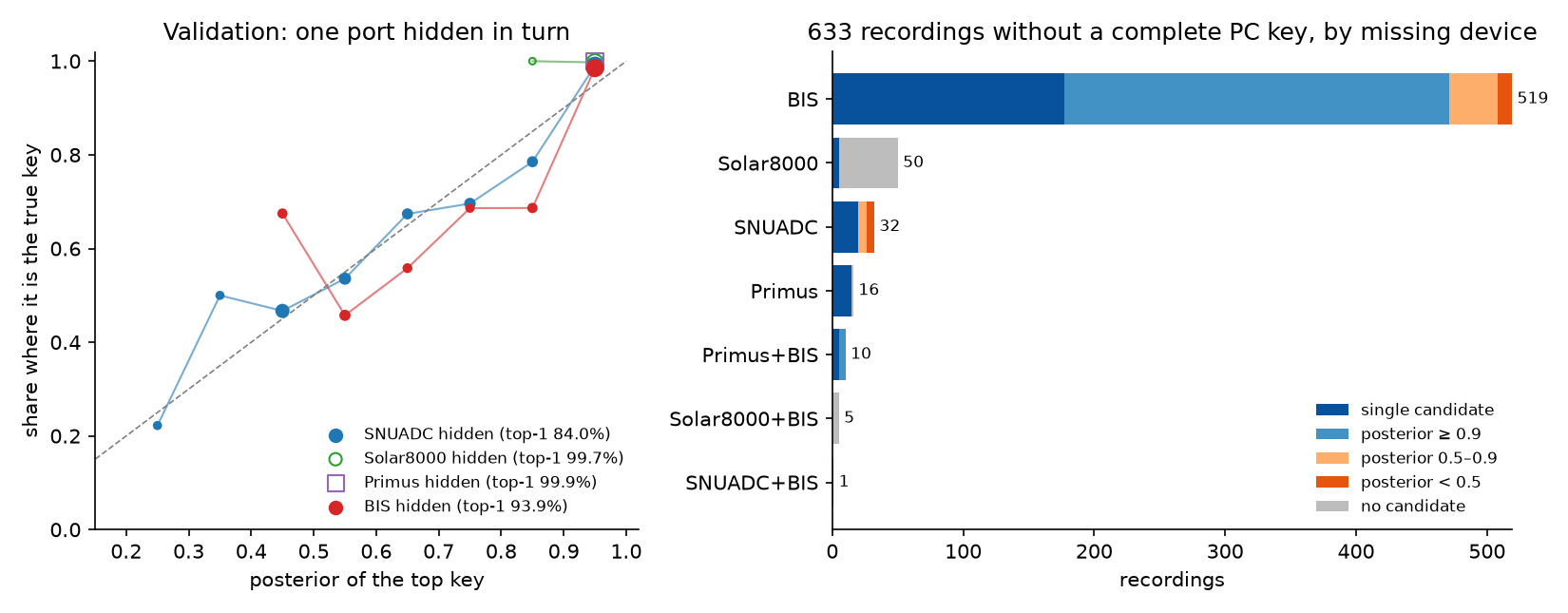
- The PC key is complete for 5,755 recordings (90%) and takes 65 values; 37 of them have at least 20 recordings, together 5,631.
- Most of the remaining 10% have no BIS.
- Assignment by Bayes' rule (
tools/setup_assign.py): the candidates are the complete keys that agree on every core port a recording has; each is scored by how many recordings it has, by the ports of the recording's other devices (Orchestra, EV1000, Vigileo and so on) and, where measured, by the SNUADC's drift against the key's median. - Validation on the complete recordings, hiding one core port at a time and scoring each recording without itself: a hidden BIS port is recovered in 94% of recordings, and in 99% of the 5,117 assigned with a posterior of at least 0.9; a hidden Solar8000 or Primus port in more than 99.7%; a hidden SNUADC port in 83% (99% of the 3,673 at 0.9 or more). Below 0.9 the posteriors are only roughly calibrated.
- Assigned: 517 of the 633 incomplete recordings get a key with a posterior of at least 0.9, among them 468 of the 519 without a BIS; 33 more between 0.5 and 0.9. 51 match no complete key, most of them missing the Solar8000's port, and 32 stay below 0.5.
- The oximeter frame clock (18 October;
tools/frame_an.pyon up to 30 complete recordings per key and the 116 unassigned): 1,169 of 1,350 recordings had a usable ECG and PLETH stretch, and the raw PPG peak locked to a frame clock, with both halves agreeing within 3 ppm, in 656. Within a key the frame clock is a strong fingerprint: 88% of recordings lie within 3 ppm of their key's median, against 19% of the release's median, and key medians range from +7 to +92 ppm. Two keys hold two clearly different rates (interquartile ranges of 57–58 ppm), probably two oximeter modules on one PC. - With the frame clock added to the assignment, 521 of the 633 incomplete recordings reach a posterior of at least 0.9 (517 before), and those below 0.5 fall from 31 to 18. The gain is small because only 40 of the incomplete recordings have a frame clock: most of the rest have no usable PLETH stretch or no lock. Validation is unchanged within a percentage point.
Observations it supports
| Observation | Status | Summary |
|---|---|---|
| Device clock drift depends on the setup | established | The drift of the SNUADC's and the BIS's timestamps against the recorder PC is largely set by the setup: knowing a recording's PC key (the serial ports of its four core devices) puts the SNUADC's drift within 3 ppm of its setup's median in 97% of cases and the BIS's in 83%, against 34% and 17% for the release's median. On the whole release's correction intervals the same test gives 71% and 60% (Identifying the recording setup of every case). |
| The oximeter's frame clock is a fingerprint of the setup | established | The rate of the oximeter's 30 Hz frame clock against the SNUADC sample clock is fixed per recording setup (+7 to +92 ppm across setups) and repeats within about 2 ppm inside a recording, so it identifies the hardware a recording was made on. |
Open questions
- Does the setup still fix the drift on the whole release? (conflict between studies). The register's drifts come from the correction scan's cases (472 SNUADC step-mode and 1,627 BIS recordings, one duration-weighted rate per recording, including the −0.95 ppm stamp arithmetic). There the PC key puts 97% of SNUADC and 83% of BIS drifts within 3 ppm of their setup's median. Rerun on the whole release's correction intervals (When each device's clock is corrected, in every recording: 642 SNUADC and 1,939 BIS recordings), the same test gives 71% and 60% (against 25% and 17% for the release median). The setup still narrows the drift a great deal, but less than the register says; the difference may be the drift's variation within a recording (a median 3.5 ppm for the BIS), which a single interval does not average out. Which rate per recording the register should use is not decided.
- Assigning the last 112 recordings to a setup (next step). Done for most: 521 of the 633 recordings without a full key are assigned with a posterior of at least 0.9 (99% right in validation, with the frame clock added). The remaining 112 have no matching key (51) or no fingerprint that separates their candidates; most lack a usable PLETH stretch for the frame clock. They take the release's values until another fingerprint is found.
- Splitting a PC key into the units it carried (next step). A key is a PC's cabling, not its devices: the busiest key holds 755 recordings, its SNUADC's and BIS's drifts show more than one unit, and two keys hold two distinct oximeter frame clocks. Drift units and frame clocks could split a key into periods with one set of devices, which is what the per-setup delays and rates really belong to.
- Do the ways of recognising a setup agree? (next step). Tabulate, per PC key, the drift units, the oximeter's frame clock, the PPG sawtooth rate and delay, the correction mode and the heart-rate delay group, to see whether they name the same setups and where a key hides two.
- Does the value side depend on the setup? (next step). Only department has been tested for value-side habits (urine output is charted much more finely in thoracic surgery). The PC key is a finer grouping: rounding habits, analysers and devices may follow the theatre.
- One PC key, one PC (untestable assumption). The register treats each PC key as one recorder PC. Two PCs cabled identically would share a key; the release cannot show it directly, though Two heart-rate delay groups, one poll apart found keys that separate their cases almost perfectly (purity 0.90–0.97), and clock fingerprints could find exceptions.
- Is a recording without a BIS on the same PC as its key's other recordings? (untestable assumption). The assignment assumes that a recording made without a BIS used the same PC as the complete recordings that share its other ports. Validation hides the BIS of recordings that had one, so it cannot test this; a BIS-free recording on a PC kept only for such cases would be assigned to the wrong setup. Clock fingerprints would test it.
Code
Figures
Tags: time side