Records out of order at SNUADC resets, and where the lost time goes
At every SNUADC reset the five records after it are written out of order: two continue the old timing and three start the new. Put back in order, the waveform runs on with no samples missing; the 18–20 ms lost at each reset goes missing inside the last old-timing record, and an extra zero sample follows.
| Date | 2026-10-17 |
| Status | current |
| Methods | Reading the stamps, Does the waveform run on? |
| Techniques | Junction scores, Null controls |
| Clocks | SNUADC sample clock, Recorder PC clock |
| Devices | SNUADC, Vital Recorder |
| Variables | ECG lead II (SNUADC), Arterial pressure (SNUADC), Plethysmogram (SNUADC) |
Background
The correction scan (Clock corrections in every file) found that the records inside a reset join badly, and the paced ECG (Paced ECG as an independent clock) that 17.7 ms of signal is lost at each reset with no samples missing at any junction. The SNUADC firmware schedules each sample 2 ms after the last, or at once if it is late, so a stall longer than 2 ms is never sampled.
Data
315 resets with the standard stamp pattern, then 392 resets in 174 of 182 step-mode cases with clock fits, in
every SNUADC channel. A census of the record stamps of all 6,388 files (17 October;
tools/snuadc_stamp_census.py) then classified every place a record is stamped before the
previous one ends, in the 6,321 files whose records do not overlap throughout.
Method
For each reset, the records were classified by stamp: on the old grid (the last record before the reset plus 0.2 s, 0.4 s) or on the new grid (the first early-stamped record plus 0.2 s, 0.4 s). Junction scores compared file order with old-grid-then-new-grid order. With the records reordered and the zero sample removed, every sample boundary within ±0.3 s of the cluster was tested for a time gap of m samples: the 20 samples either side were fitted with one quadratic with the second side shifted by m, for m = 0 to 15, on the plethysmogram and arterial pressure. Random windows far from resets were the control.
Results
- The order: two old-grid records, then three new-grid records, each in file order (usually file positions 1 and 3, then 0, 2 and 4). Every junction is then as smooth as an ordinary record boundary, no samples are missing at any of them, and the stamps make one clean step back of −0.480 s.
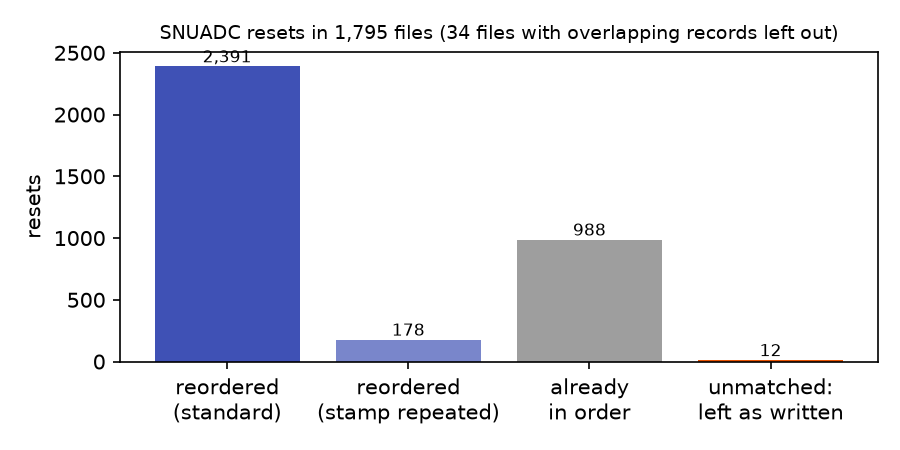
- The same clusters in every SNUADC channel, and every sample survives. About 1 reset in 16 interleaves differently and gives one record its neighbour's stamp; the same rule orders it (24 records restamped). 9 resets were already in order.
- One extra zero sample: 335 of 392 resets hold one sample reading 0 in every channel at once. Lines fitted either side meet as if it were not there (−0.97 samples, median), so it carries no time: a filler.
- The lost time is in the last old-grid record. 81 of 97 confident plethysmogram detections (m = 6–13) fall in that record, against about 2 expected by chance; with arterial pressure, 99 of 392 resets show it there. The gap is about 11 samples (IQR 10–12), at no fixed position, and always before the zero sample.
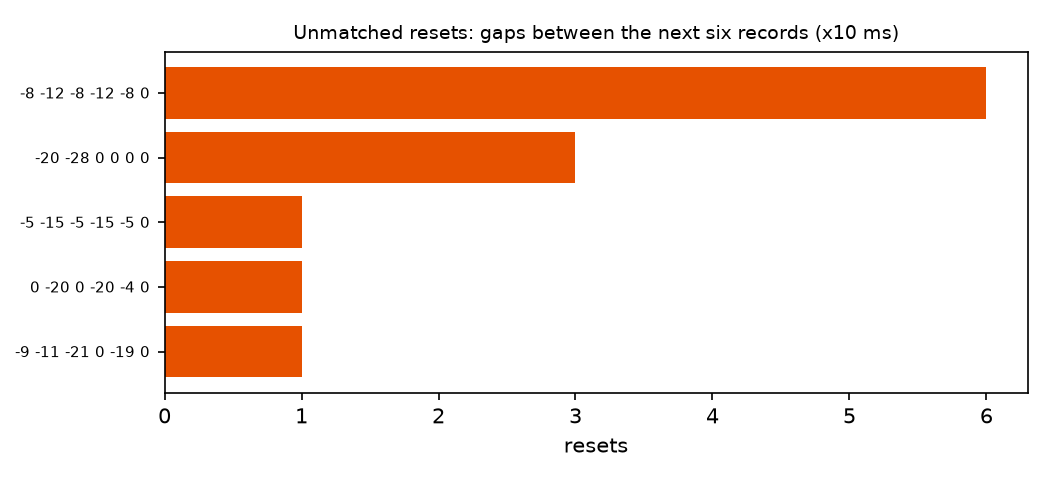
- In every file (census): 1,785 files write their reset clusters out of order (2,569 resets, 178 of them with a repeated stamp), and 820 files write them already in order (988 resets). No file does both, which points to two recorder or firmware versions. 12 backward steps of reset size match neither (left as written; most are small interleaved steps of 8–12 ms), and 496 are small steps of the frequent-correction mode.
- 34 files must be excluded from the rule. Their records overlap the next record far more often than resets do (in 20 of them, 4–95% of all record junctions step back). There the rule matches 115,487 times by coincidence and would scramble the signal. None of these files is in the current builds or clock fits; the import needs a guard before a full build (see In 34 files the SNUADC records overlap throughout).
Discussion
Sampling pauses for about 20 ms just before the recorder starts the new grid, and the time is never sampled; a filler sample follows. With the filler counted, the true pause is about 19.7 ms, consistent with the 17.7 ms lost on the sample count. The TimeNet import now puts the records in sampling order (resets.py), and the clock fits use the same order. The zero sample is still stored, and the loss is added at the end of the record rather than at its true point inside it.
Observations it supports
| Observation | Status | Summary |
|---|---|---|
| About 20 ms of signal lost at every SNUADC reset | established | At each step-mode reset the acquisition pauses for about 20 ms inside the last record before the new timing, and that time is never sampled: 17.7 ms on the sample count (Signal lost at a SNUADC step-mode correction), once the filler sample is counted. Every record still holds 100 samples, so nothing in the file shows it. |
| All SNUADC channels share one clock | established | Every SNUADC waveform track of a case (ECG leads, ART, PLETH, CVP) has the same first stamp, the same record timing and the same corrections. They are stamped together. |
| An extra zero sample after most resets | established | Most SNUADC resets (335 of 392) contain one sample that reads 0 in every channel at once, a little after the reset. It carries no time of its own: the signal either side runs on as if it were not there. |
| Five records out of order at every SNUADC reset | established | At each step-mode reset the five records after it are written in the wrong order: two continue the old timing and three start the new, interleaved. Read in file order, or sorted by stamp, one second of signal is scrambled. |
| Stamp-based loaders lose samples at overlaps | likely | Loaders that place samples by their stamps onto a grid overwrite samples where stamps overlap: about 0.48 s at every SNUADC reset, and one sample about every 35 minutes from the stamp arithmetic. |
| In 34 files the SNUADC records overlap throughout | open | In 34 files the SNUADC records step back over their neighbours far more often than resets explain: in 20 of them 4–95% of all record junctions overlap, by up to about 100 ms. The reset-order rule matches there by coincidence. |
Limitations
The gap is located only where the signal is steep (about one reset in four). The public firmware may not be the version deployed. The census classifies by stamps alone; the 988 in-order resets were not checked in the signal.
Open questions
- Two firmware versions behind the reset order (weakly supported hypothesis). 1,785 files write their reset clusters out of order and 820 in order, and no file does both. Two recorder or firmware versions would explain the clean split, but nothing in the release shows which file ran which; file headers and recording dates (hidden in the release) would tell.
- 34 files whose records overlap throughout (unexplained phenomenon). Mostly explained since: records written twice and two interleaved streams (Eight recordings store whole messages twice, In some recordings two unrelated streams are interleaved in one track); whether these account for all 34 is not checked (In 34 files the SNUADC records overlap throughout).
- Twelve unmatched resets (unexplained phenomenon). Twelve unmatched resets have small interleaved steps of 8–12 ms. Whether they are resets of a different size or something else is not known.
- The filler sample (unexplained phenomenon). Why most resets hold one extra zero sample, a little after the gap, is not known.
- A guard on the reorder rule for overlapping files (next step). The reorder rule matches 115,487 coincidental clusters in the 34 overlapping files. None of them are in the current builds or fits, but before any full import the rule must detect these files and leave them alone, with a test on one of them.
- Census figures without the anomalous files (next step). The census summary now leaves out the 34 anomalous files and counts them separately. The figures made before that change still include them, so they need re-exporting from the new summary, and the summary change needs committing in vitaldb-bench.
Code
- TimeNet VitalDB reader:
…/vitaldb/resets.py,…/tests/test_resets.py - vitaldb-bench:
tools/clock_model_fit.py,…/adhoc/reset_gapscan.py,…/adhoc/reset_glitch.py
Figures