Eight recordings store whole messages twice
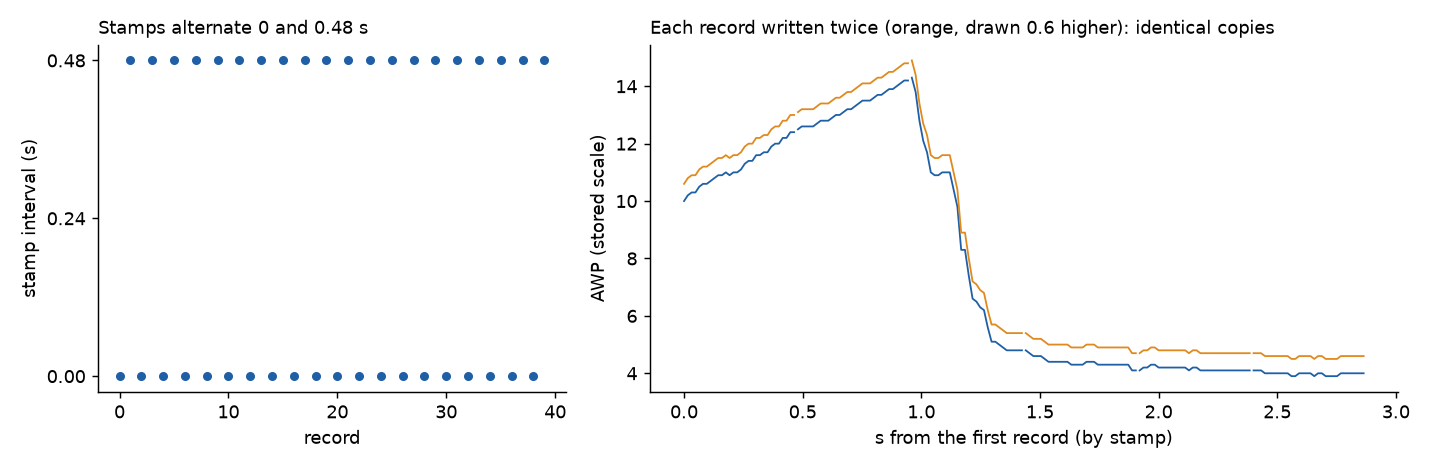
In 8 recordings 15–48% of the waveform records are byte-for-byte copies of the record before them, with the same timestamp: case 15, case 364, case 1946, case 3865, case 4857, case 5414, case 5595 and case 5619. SNUADC, Primus and BIS are affected equally, so the recorder, not a device, wrote them twice.
| Status | established: shown on many cases, with a control. |
| Devices | Vital Recorder, SNUADC, Primus anaesthesia machine, BIS monitor |
| Variables | ECG lead II (SNUADC), Arterial pressure (SNUADC), Plethysmogram (SNUADC), Capnogram (Primus), Airway pressure (Primus), BIS EEG |
| Supersedes | In 34 files the SNUADC records overlap throughout |
What it means
Read in file order, the duplicated messages play twice: a 0.2 s SNUADC record (0.48 s Primus, 0.125 s BIS) repeats, the samples outrun the stamps, and anything that counts samples to keep time drifts. In case 5595, 40% of every device's records are copies (89,956 SNUADC records identical to the one before). Isolated single copies also occur in about 500 other recordings (under 0.1% of their records).
What is done about it
Drop a record that is identical to the previous one and carries the same timestamp. The copies are found by the step between records being exactly minus one message, then confirmed by comparing contents.
Evidence
| Study | Date | Status | Summary |
|---|---|---|---|
| Message sizes and the steps between records | 2026-10-19 | draft | Every record in every waveform: SNUADC writes messages of 100 samples (0.2 s), Primus 30 (0.48 s), BIS 16 (0.125 s), CardioQ no fixed size. Backward steps outnumber gaps by about a hundred to one and come from a few recordings with duplicated or interleaved records. Primus gaps are whole lost messages; most SNUADC and BIS gaps are not. |
Figures