Anaesthesia record times are rounded up
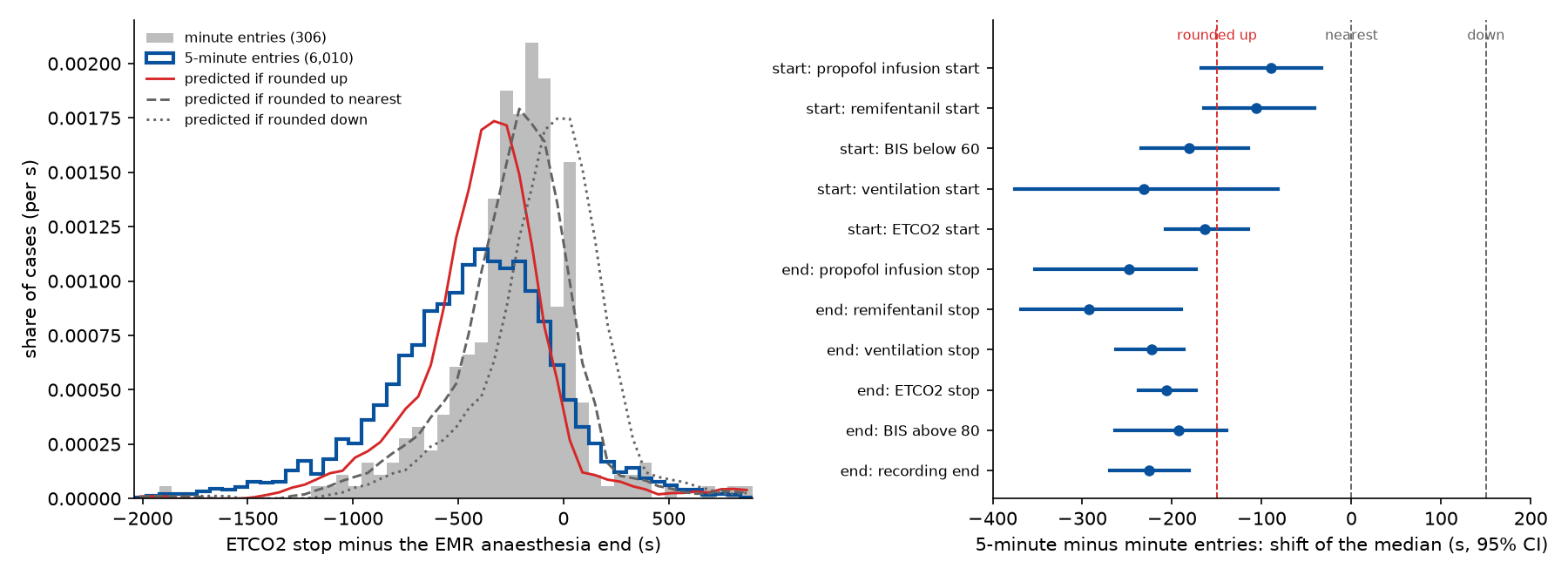
Anaesthesia start and end entered on a 5-minute mark sit 90–290 s later, against device markers, than entries typed to the minute. Rounding up to the next 5 minutes fits every one of 11 markers better than rounding to the nearest or down.
| Date | 2026-10-12 |
| Status | current |
| Methods | Clinical and laboratory times |
| Techniques | Null controls |
| Clocks | Hospital records clock, Recorder PC clock |
| Devices | Clinical records, Infusion pumps, BIS monitor, Primus anaesthesia machine, Vital Recorder |
| Variables | Anaesthesia record events, Infusion pump rates and volumes, BIS index, Primus ETCO₂, PIP and RR |
Background
The clinical table's anaesthesia and operation times come from the electronic anaesthesia record. Some are typed to the minute, many fall on 5-minute marks. If 5-minute entries are rounded, the rounding direction decides where the true event lies.
Data
All 6,388 cases.
Method
Device markers on the recorder clock (propofol and remifentanil infusion start and stop, BIS below 60 or above 80, ventilation and ETCO₂ start and stop, recording end) were compared with the EMR time: D = marker − EMR time. Cases were split by the recovered case clock into 5-minute entries (on an absolute 5-minute mark) and minute entries. The minute group's D is the documentation lag; convolving it with each rounding kernel (nearest, floor, ceiling) predicts the 5-minute group, scored by kernel-density log-likelihood.
Results
- Every marker agrees in sign: the 5-minute group's median shifts by −89 to −293 s against the minute group, and all 11 confidence intervals exclude 0. Rounding up predicts −150 s, nearest 0 and floor +150.
- Ceiling wins for all 11 markers, with small margins at anaesthesia start (induction markers spread widely) and large ones at anaesthesia end.
- Shifts beyond −150 s (median about −200 s) suggest 5-minute entries are also written a little later, perhaps retrospectively.
- ETCO₂ stop against anaesthesia end, as an example: the 5-minute entries (6,010) sit left of the minute entries (306), close to what rounding up predicts and far from rounding to the nearest or down, and further left still.
| Parameter | Value | Status | From |
|---|---|---|---|
| EMR 5-minute entries, rounding | (t − 300 s, t]; estimate t − 150 s (SD 87 s); observed shift against minute entries −89 to −293 s | measured | Anaesthesia record times are rounded up |
Discussion
Read a 5-minute EMR time t as the interval (t − 300 s, t]: the event is estimated at t − 150 s (SD 87 s), and the entry is known no earlier than t plus the documentation lag. Minute entries keep ±60 s. The clinical_time labels in the TimeNet import carry these intervals. The extra ~50 s cannot be separated from rounding with these data.
Observations it supports
| Observation | Status | Summary |
|---|---|---|
| Anaesthesia record times on 5-minute marks are rounded up | established | An anaesthesia start or end entered on a 5-minute mark was rounded up to it: the event happened in the 5 minutes before, and on average a little earlier still. Clear for anaesthesia end; for anaesthesia start the margin is small, and the value model (How the anesthesia start time was charted) prefers rounding to the nearest mark. |
| The EMR clock's offset cannot be separated from documentation lag | established | Both routes between the EMR clock and the recorder run through the case start, so any EMR clock offset cancels. Without a time from outside the release it is confounded with how late entries are made. |
Limitations
The two groups may come from different staff or workflows. Rounding is measured for anaesthesia start and end, and assumed for operation start and end.
Open questions
- About 50 s more than rounding (unexplained phenomenon). The anaesthesia record times sit later than rounding alone explains. Documentation lag and an offset between the EMR clock and the recorder cannot be separated with these data.
- Rounded up or to the nearest: two studies disagree (conflict between studies). For anaesthesia start, the device markers here favour rounding up, but only by a small margin, while the value model, which compares the charted time with the recording start, prefers the nearest mark by 47 BIC points (How the anesthesia start time was charted). For anaesthesia end the two agree (rounded up). Operation start and end were not measured here; their value models give the nearest mark and rounding down (How the operation end time was charted, Bias in charted intervals), while the EMR timing entry (Anaesthesia record events) treats every 5-minute entry as rounded up. Not reconciled.
Worked examples
| Example | Side | Status | Summary |
|---|---|---|---|
| Post-induction hypotension, from the charted start and from the devices | time | draft | The charted anaesthesia start comes a median 14 minutes before the patient is induced; measured from it, "hypotension within 20 minutes of induction" is found in 27% of 2,913 patients, against 51% from the devices' induction, and the label changes for a quarter of patients. |
| Time from a vasopressor bolus to the pressure response | both | planned | How quickly arterial pressure responds to a phenylephrine or ephedrine bolus, with the charted dose times' rounding taken into account. Not feasible in VitalDB, which records bolus totals but no bolus times; kept for a dataset that does. |
Code
References
- Rietveld P. Rounding of arrival and departure times in travel surveys: an interpretation in terms of scheduled activities. J Transp Stat. 2002;5(1):71-81. ↗