The charted anesthesia start time is a mixture of 5 ways of writing a clock time (nominal_0740, nominal_0730, nearest_10min, nearest_5min, clock_minute), modelled as an offset from a device time.
Anaesthesia start is an event time copied from the EMR into the case file. Its chronon is 1 minute.
The dataset paper (Lee et al., Sci Data 2022) says anaesthesia start and end are recorded at 5-minute intervals. That holds for anaesthesia end, but not for most anaesthesia starts.
Of the gaps from anaesthesia start to op start, 48.4% are multiples of 5 min, against 20% by chance.
The clock minute is reconstructed from the admission date (see the clock-reconstruction study). Two cases with an admission that is not a whole minute, case 1342 and case 5723, are flagged clock_uncertain.
The charted start falls before recording start in 91.7% of cases (median 583 s).
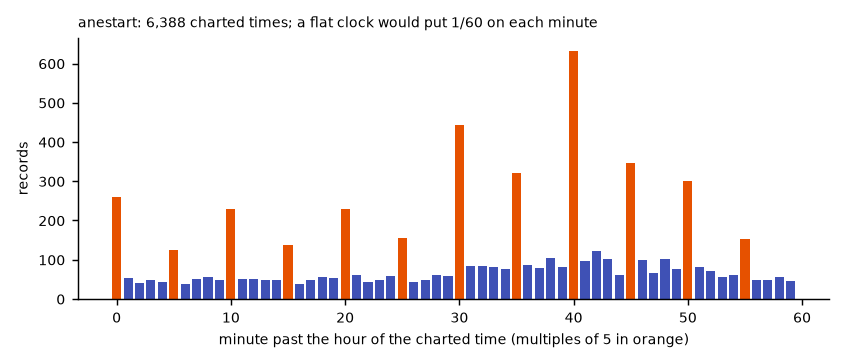
The minute past the hour of every charted time: the heaps on multiples of 5, and at the standard first-case times, are the rounding modes the model fits.
Only 52% of starts fall on a 5-minute clock mark. Marks ending in 0 are favoured over those ending in 5, and :30 and :40 dominate.
Of the 1,870 anaesthesia starts between 07:00 and 07:59, 420 are at exactly 07:40, which suggests a nominal first-case start time.
Rounded starts are written to the nearest mark: nearest beats ceiling by 47 BIC points and floor by 289.
The first-case clock-time density improves the model by 722 BIC points; almost no first case starts before 07:30.
Evenings and nights round much more; emergencies round a little more to 5 min.
The package reproduces the stored log-likelihood within 0.11 (JAX fitter vs engine grid).
Anaesthesia start by department: 52–56% of charted minutes fall on a multiple of 5 (20% if unrounded) and
26–34% on a multiple of 10, with no clear difference between departments. Emergency cases are rounded slightly
more often (58.7% on a multiple of 5, against 51.2% for elective).
An anaesthesia start or end entered on a 5-minute mark was rounded up to it: the event happened in the 5 minutes before, and on average a little earlier still. Clear for anaesthesia end; for anaesthesia start the margin is small, and the value model (How the anesthesia start time was charted) prefers rounding to the nearest mark.
The capture windows of the two nominal first-case values are not identifiable.
The charted start sits a median of about 10 minutes before monitoring begins, and device-marked induction a
median 14 minutes after it (see the open question below): it marks the start of anaesthesia care, not induction.
Anaesthesia start ignores the 5-minute rule(unexplained phenomenon). Why does anaesthesia start not follow the 5-minute rule the paper describes? Were there two entry methods, or a change of system partway through?
What event anaesthesia start marks(unexplained phenomenon). Partly answered: device-marked induction (BIS loss of consciousness, else the propofol pump start) comes a median 14 minutes after the charted start (10th–90th percentile 6 to 25 minutes) in 2,913 cases (Post-induction hypotension, from the charted start and from the devices), so the charted time marks the start of anaesthesia care, not induction. Which event of care it records (arrival, monitoring, pre-oxygenation) is open.
No time axis for era effects(untestable assumption). Resolution cannot be checked by era: case IDs are random (the release says so, and they are uncorrelated with anything dated), and dates are removed. The models assume rounding habits were constant over the years the data cover. Department makes no difference; emergency cases are rounded a little more often.
How a true value becomes the recorded one. The rules are tried in order: a record not taken by an earlier rule is taken by this one with the probability shown (where its condition holds); the last rule takes the rest. Shares of all records depend on the conditions and the true value, so the model must be evaluated for them; the probabilities below are the fitted ones.
Order
Rule
Rounds to
Probability if reached
Applies when
1
nominal_0740
written as 460
13.2 %
true clock minute in [440, 480); reference clock minute in [390, 540)
2
nominal_0730
written as 450
9.6 %
true clock minute in [430, 470); reference clock minute in [390, 540)
3
nearest_10min
10 clock minute (nearest)
11.5 %
varies with emop, ref_window
4
nearest_5min
5 clock minute (nearest)
21.7 %
varies with emop, ref_window
5
clock_minute
1 clock minute (floor)
the rest
always
nominal_0740: first-case start written as 07:40 when the true start is 07:20-08:00; window width not identifiable (+-20 and +-40 fit equally)
nominal_0730: first-case start written as 07:30 when the true start is 07:10-07:50
Recorded resolution
1 min (chronon) (modelled at 1)
True-value density
reference_offset_spline
Covariates
ref, ref_window (first_case if recording starts 06:30-09:00; evening_night if it starts 19:00-06:00; otherwise day), emop
Acute kidney injury after surgery against intraoperative urine output (mL/kg/h), fitted once on the recorded numbers and once per draw from the true-value distributions: the rounding moves 14% of cases across the oliguria threshold, but widens the confidence interval of the cohort's regression by at most 4%.
One label per patient, oliguric or not, from three rounded numbers: 10% of labels are uncertain and 2.6% are expected to be wrong, which sets a floor under the error any model can be measured to have. A typical model is barely affected; a good one is.
Intraoperative urine output per kilogram per hour, from three rounded inputs, as a probability distribution per case: one case in ten cannot be placed confidently on either side of 0.5 mL/kg/h.