The Primus stamp step at each airway-pressure pause
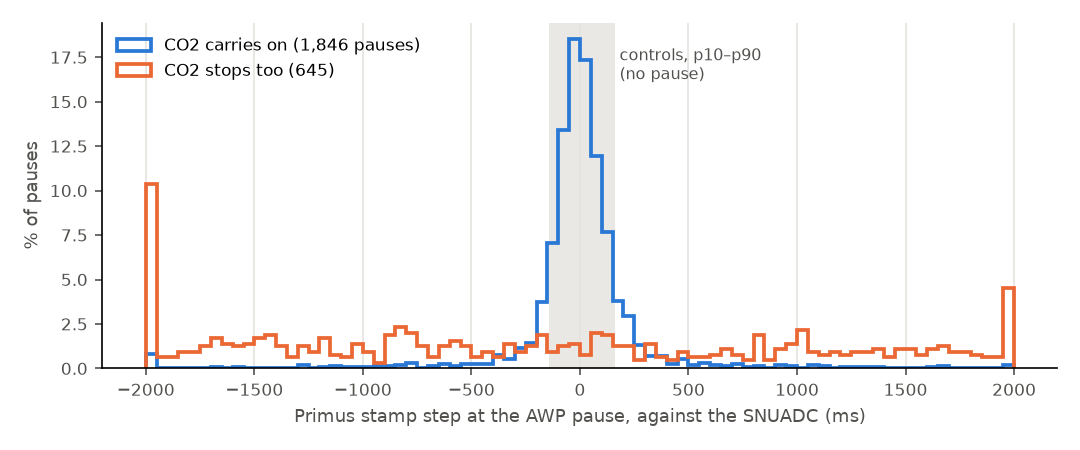
Measured directly at 2,491 pauses in 1,021 recordings: where CO₂ carries on through the AWP pause (74%), the Primus stamps barely step (median −1 ms, p10–p90 −164 to +187 ms, close to the no-pause controls); where CO₂ stops too (26%), they step by up to seconds. No step undoes the drift built up since the last pause.
| Date | 2026-10-19 |
| Status | current |
| Methods | One event, two clocks |
| Techniques | Windowed cross-correlation, Null controls |
| Clocks | Primus clock, SNUADC sample clock, Recorder PC clock |
| Devices | Primus anaesthesia machine, SNUADC |
| Variables | Airway pressure (Primus), Capnogram (Primus) |
Background
At each AWP pause (about 21 s every 7,230 s; The Primus AWP stops for about 21 s every 7,230 s) the Primus stamps step against the SNUADC. The 10-minute windows of The Primus ventilator against SNUADC, by breaths see these steps only through fitted lines, and windows that straddle a pause mix two lags.
Data
All 6,388 recordings were read; 1,021 had AWP, CVP, at least one AWP pause with enough breathing either side, and at least 200 mechanical breaths. 2,491 of their 3,665 pauses were measurable; up to two control moments per recording at least 25 minutes from any pause.
Method
The airway-pressure-to-CVP lag in 2-minute windows (stepped by 1 minute) for 20 minutes before and after each gap, with the SNUADC on its stamp model; a line on each side, and the step as their difference at the middle of the gap. Recorded with each step: gap length, drift built up since the previous pause, the Primus's small whole-sample corrections nearby, whether CO₂ also stops, and whether a SNUADC reset falls within 20 minutes. Controls: the same measurement where no pause is near.
Results
| Pauses | Count | Step, median (p10–p90) | Within 150 ms |
|---|---|---|---|
| CO₂ carries on | 1,846 | −1 ms (−164 to +187) | 76% |
| CO₂ stops too | 645 | −269 ms (−1,965 to +1,609) | 8% |
| Controls, no pause | −10 ms (−144 to +162) |
- Unrelated to the drift built up since the previous pause (r = −0.03; 0.3% of it taken back), to the gap's length (r = −0.05) and to the small whole-sample corrections (r = 0.00).
- A nearby SNUADC reset does not enlarge the step (median |step| 87 ms with, 119 ms without).
- Precision: a median standard error of 37 ms per step.
Discussion
The regular AWP pause is not a clock correction in itself: when the CO₂ stream carries on, the stamps keep their
timing. The large steps come when both waveforms stop, which looks like the recorder losing and re-opening the
Primus connection and re-anchoring its stamps to the PC. Even so, synchronisation is best with a fresh offset and
slope at every AWP pause, not only at breaks: predicting each 10-minute window from the others gives a median error
of 55 ms that way, against 82 ms with new lines only at breaks and 64 ms with lines joined at the regular pauses
(1,067 recordings, tools/primus_pause_aware.py). The regular pauses are small steps on
average, but not small enough to ignore.
Observations it supports
| Observation | Status | Summary |
|---|---|---|
| The Primus AWP stops for about 21 s every 7,230 s | established | In 5,502 recordings the Primus airway-pressure waveform has gaps of 19–23.5 s (whole messages of 0.48 s, mostly 21.12 s) that recur every 7,230 s, the Primus's correction interval; a clock correction follows about 21.6 s after. The CO₂ waveform carries on through 90% of them. The 21 s of AWP are lost, not merely re-stamped. |
Limitations
The step includes any change in the physiological airway-to-CVP delay across the pause. Pauses within 20 minutes of a recording's edge, or with too little breathing either side, are not measured.
Open questions
- What the stamps re-anchor to when both waveforms stop (weakly supported hypothesis). Steps of up to seconds come where AWP and CO₂ stop together. A re-opened connection re-anchoring the stamps to the PC's arrival time is the working explanation; the recorder's message log around those gaps would test it.