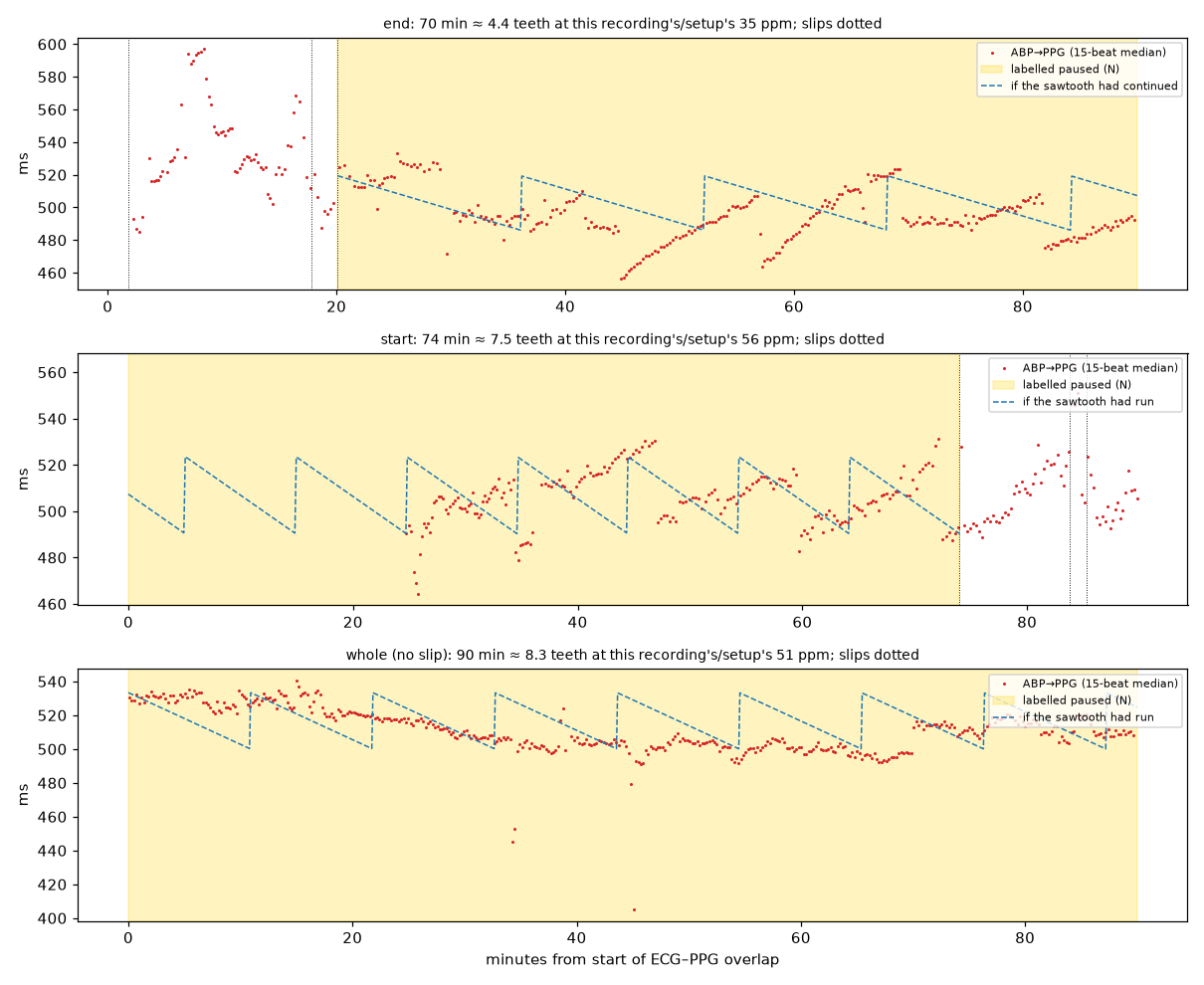
Where the PPG sawtooth stops
In some stretches no slip comes although several were due. The PPG delay there is flat, not hidden: the monitor keeps framing, and only the content's drift against the frames has stopped.
| Date | 2026-10-11 |
| Status | current |
| Methods | Clocks carried in the signal |
| Techniques | Phase-step detection, Null controls |
| Clocks | Pulse oximeter frame clock |
| Devices | Solar8000 monitor, SNUADC |
| Variables | Plethysmogram (SNUADC), Arterial pressure (SNUADC) |
Data
98 stretches (67 hours) where slips were due but none was seen; 32 whole recordings (47 hours) without a slip.
Method
In each stretch the case's own sawtooth (one frame, at the recording's rate, best of 50 phases) was fitted against a mirrored sawtooth as the control. Slip prediction looked one tooth beyond the first and last accepted slips and accepted a slip there only if a step showed.
Results
- The delay is flat: median slope −0.15 times the sawtooth rate; only 13 stretches creep without slipping.
- The frame clock keeps running through them: found in 82 of 98 stretches, at the rate of the corrected part of the same case to within 1 ppm.
- Whole recordings without slips are robust, but at least one shows a slow drift of about 7 ppm and a 20 ms step instead: possibly a much slower sawtooth.
- Slip prediction moved tiers A + B from 26% to 29% of time, with unchanged error.
Discussion
Stretches that pass the test are labelled N (offset only, no sawtooth). Recordings whose own tooth rate differs from their setup's by more than 20% use their own rate, and none of their teeth is labelled N.
Observations it supports
| Observation | Status | Summary |
|---|---|---|
| The PPG sawtooth sometimes stops | open | In some stretches, and some whole recordings, no frame slip comes although several were due. The delay there is flat and the frame clock keeps running; what stops the content's drift is not known. |
Limitations
What replaces the sawtooth at the start and end of some recordings is not simply flat (fast ABP→PPG ramps of several ms per minute). Open.
Open questions
- What replaces the sawtooth (unexplained phenomenon). At the start and end of some recordings the PPG lag is not flat but ramps by several ms per minute against arterial pressure. Its cause is not known.
Worked examples
| Example | Side | Status | Summary |
|---|---|---|---|
| Pulse arrival time in two correction steps | time | draft | The time from the ECG R wave to the pulse at the finger, as stored, after the PLETH's sawtooth is removed, and after its device offset is removed, smoothed by maximum likelihood, with the arterial line as the reference. |
Figures