The SNUADC clock through the Solar8000 numerics, whole release
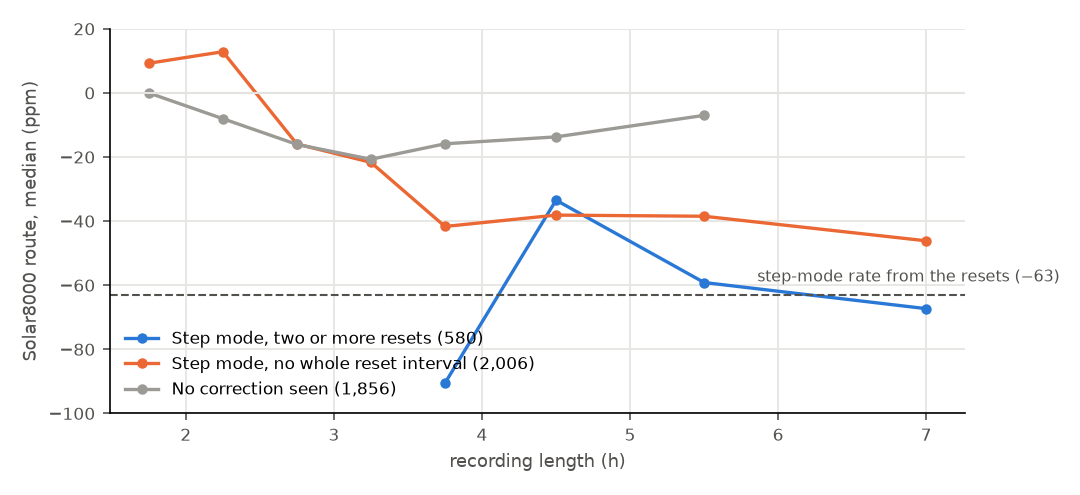
On the SNUADC's own sample count, the delay from the waveform to the PC-stamped Solar8000 heart rate and mean arterial pressure ramps at the SNUADC's drift against the PC, measured without its stamps or resets. In recordings with whole reset intervals it agrees with them (−63 ppm; median difference +1.5 ppm, 581 recordings). It is too noisy per recording, and in recordings under about 4 h its rate is biased toward zero, so it cannot yet speak for recordings without resets.
| Date | 2026-10-19 |
| Status | current |
| Methods | One event, two clocks, Delays and averaging windows |
| Techniques | Windowed cross-correlation |
| Clocks | SNUADC sample clock, Recorder PC clock, Solar8000 clock |
| Devices | SNUADC, Solar8000 monitor, Vital Recorder |
| Variables | ECG lead II (SNUADC), Arterial pressure (SNUADC), Solar8000 heart rate, Solar8000 ART and CVP numerics |
Background
The Solar8000 computes heart rate and mean arterial pressure from the same ECG and arterial pressure that SNUADC samples from its analogue outputs, and the recorder stamps each value on arrival with the PC clock. Within a recording the numeric's delay behind the waveform is fixed (Numeric delays are fixed within a case, different between cases). Placed on the SNUADC's sample count, the waveform drifts against the PC at the SNUADC crystal's rate, and the delay ramps with it. The 66-case pilot (SNUADC against the PC-stamped heart rate) gave −65.3 ppm against −66.7 ppm from the stamp model.
Data
All 6,388 recordings were read; 50 had no 500 Hz ECG. A rate needs at least 4 usable 30-minute blocks over 1.5 h: 4,542 recordings for the combined rate (heart rate 4,447; mean arterial pressure 2,969). Reset-interval rates for 581 of them come from the clock-network edge table; the shared-burst residuals of the adopted stamp model (model3) for comparison.
Method
Two timelines per recording: the sample count (one offset per stretch between gaps, the 17.7 ms lost at each reset added back, rate 0) and the adopted stamp model. On each, the numeric's delay was fitted per 30-minute block on a 0.05 s grid with the likelihood of Numeric delays are fixed within a case, different between cases, and a robust line (Theil–Sen) through the block delays gave the rate; heart rate and mean arterial pressure were combined by inverse variance. Recordings were grouped by SNUADC correction mode, and step-mode recordings by whether they have a whole reset interval.
Results
- Where it can be checked, it closes: in step-mode recordings with whole reset intervals the median is −63 ppm, and against those recordings' own reset intervals the median difference is +1.5 ppm (p25–p75 −24 to +36; 581 recordings; median |z| 1.11).
- Per recording it is noisy: a median standard error of 40 ppm from mean arterial pressure and 83 ppm from heart rate.
- It is biased toward zero in short recordings: in every group the median rises toward 0 as recordings get shorter (step mode without a whole reset interval: about +10 ppm under 2.5 h, −38 to −46 ppm over 4 h). A 30-minute block ramps by only about 0.11 s at −63 ppm, two steps of the delay grid, and with few blocks the robust line is pulled flat by tied delays and by the first block, which often sits apart.
- The burst check disagrees with the short-recording medians: on the adopted stamp model, the ECG–EEG burst lag in recordings without a whole reset interval has a median slope of −7 ms/h (step mode, 906 recordings) and +10 ms/h (no correction, 521), close to zero, so the port's step-mode rate the model gives them fits on average.
Discussion
A third route to the SNUADC's drift, beside the resets and the shared bursts, and the only one that needs neither the SNUADC's stamps nor the BIS. Where resets exist it agrees with them, which closes a loop through the Solar8000. Its group medians for shorter recordings are an artefact of the estimator, not evidence that those units run slow; the burst residuals support the stamp model's choice of the port's rate. The question of the long recordings that show no correction (Long SNUADC recordings with no correction at all) remains open.
Observations it supports
| Observation | Status | Summary |
|---|---|---|
| Long SNUADC recordings with no correction at all | open | 1,066 cases of 2.5 h or longer show no SNUADC correction, although at the step-mode median of −63 ppm a 0.49 s step falls due within about 2.2 h. Slower units, a third recorder mode, or both; shared bursts point to slower units (about −36 ppm where the BIS rate is known, The stamp sawtooth model for SNUADC and BIS, due only after about 3.8 h). The Solar8000 route cannot settle it: its rates shrink toward zero in recordings under about 4 h (The SNUADC clock through the Solar8000 numerics, whole release). |
Limitations
Per-recording rates are too noisy to correct a single recording. The delay grid (0.05 s) and the 30-minute blocks limit the estimator in short recordings. The Solar8000's delay occasionally steps; heart rate is truncated and polled every 2 s.
Open questions
- A finer estimator for short recordings (next step). Fitting the delay's slope directly in the likelihood (a delay that ramps within the recording), on a finer grid and without the first block, would remove the bias toward zero and let this route test recordings with no SNUADC reset.