Shared bursts between the ECG and the EEG
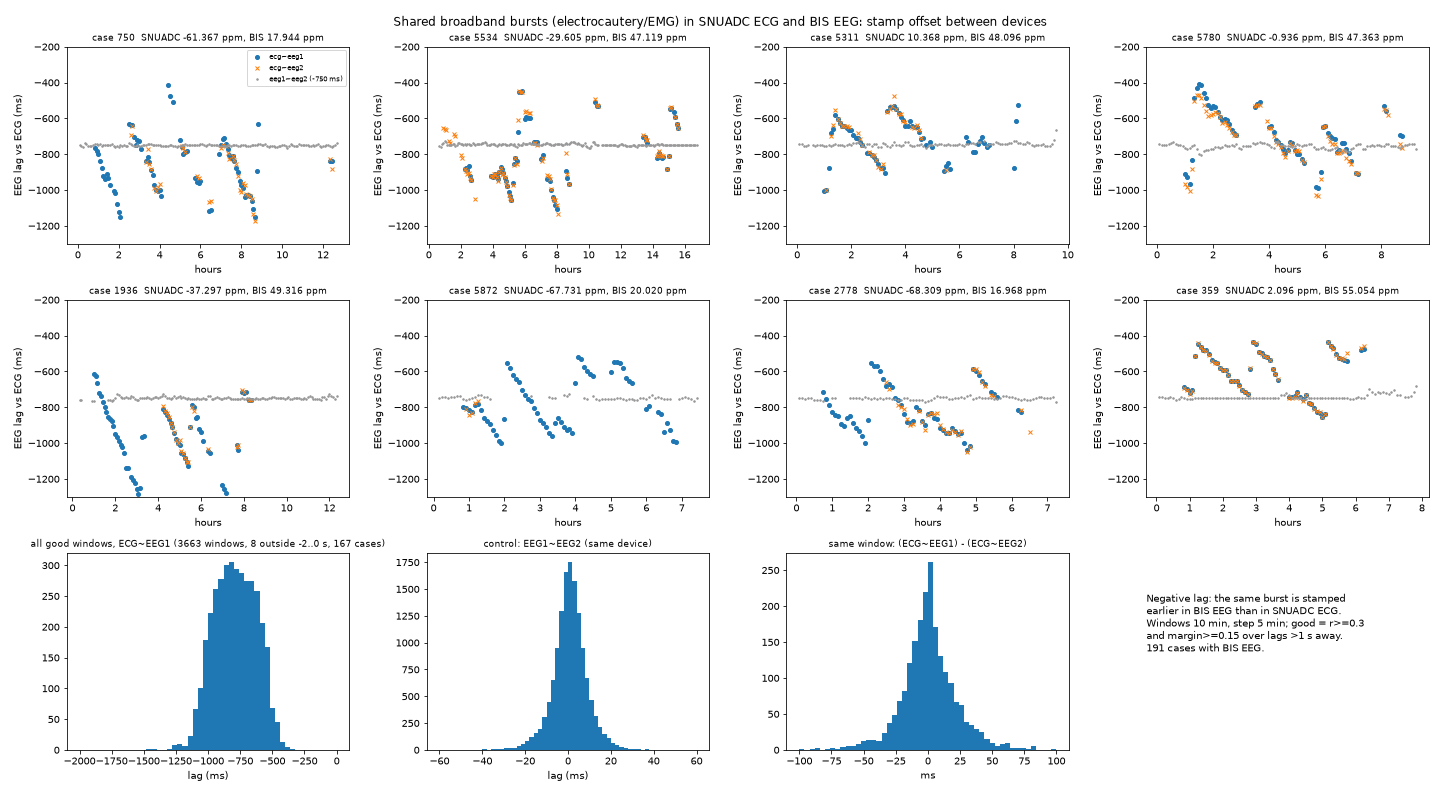
Electrocautery and muscle bursts appear in both the SNUADC ECG and the BIS EEG. Cross-correlating their envelopes gives the offset between the two devices' stamps every 10 minutes: about −0.8 s, in a sawtooth that follows both clocks' corrections.
| Date | 2026-10-12 |
| Status | current |
| Methods | One event, two clocks |
| Techniques | Windowed cross-correlation, Null controls |
| Clocks | SNUADC sample clock, BIS clock |
| Devices | SNUADC, BIS monitor |
| Variables | ECG lead II (SNUADC), BIS EEG |
Background
Two devices on separate clocks need an event both of them record. Broadband bursts (electrocautery, muscle activity) reach the ECG electrodes and the EEG electrodes at the same instant.
Data
A first probe on 30 benchmark cases with BIS EEG, then all 191 benchmark cases with BIS.
Method
The envelope is the log power of the ECG at 30–60 Hz and of the EEG at 30–55 Hz, median-filtered over 0.55 s to remove the QRS, with a 10 s running median subtracted. Each 10-minute window (stepped by 5 minutes) is cross-correlated over ±20 s, and counts as good when r ≥ 0.3 and the peak beats any lag more than 1 s away by at least 0.15. The EEG's two channels give two independent estimates per window; EEG1 against EEG2 is the control. Other candidate shared signals were tried: bursts within SNUADC, mains hum, and ventilation.
Results
- Coverage: 167 of 191 cases have at least one good window, 145 at least 5; 3,663 good windows in all.
- Offset: median −792 ms (5th–95th percentile −1,053 to −533 ms), EEG minus ECG stamp for the same burst.
- Precision: EEG1 and EEG2 agree to 11 ms (median; p90 36 ms); the control sits at 0 ± 7 ms.
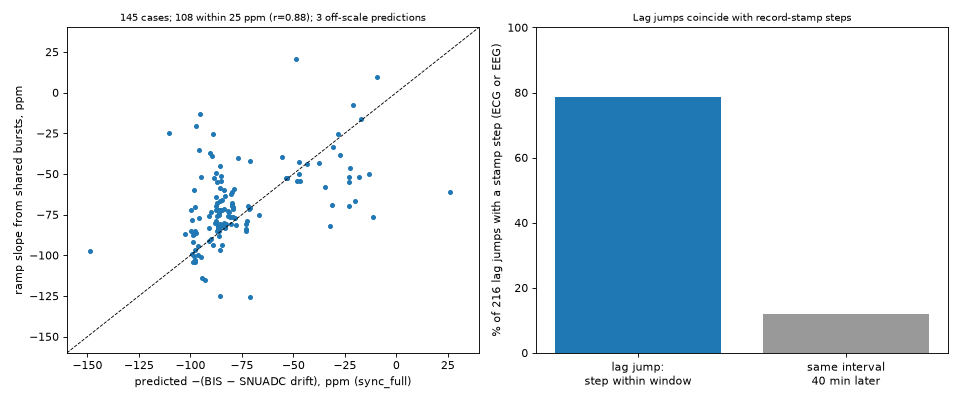
- A sawtooth, not a constant. The offset ramps for 30–90 minutes and jumps back. The ramp slope matches the difference of the two devices' drifts from their stamps (r = 0.88; within 25 ppm in 108 of 145 cases).
- The jumps are stamp steps: 79% of 216 lag jumps have a SNUADC or BIS record-stamp step in the same window, against 12% for the same interval 40 minutes later.
- Other shared signals fail. Bursts within SNUADC are rare and point to interference entering after the monitor's processing; mains hum is absent from SNUADC; ventilation is too regular to give a unique lag.
| Parameter | Value | Status | From |
|---|---|---|---|
| BIS drift against SNUADC | −72 ppm (IQR −82 to −54) | measured | Shared bursts between the ECG and the EEG |
Discussion
The first direct, artefact-based confirmation of the clock drifts, and the only measure of the absolute offset between SNUADC and BIS. Because the ramps and steps are visible in the stamps themselves, they can be corrected without any artefact (The stamp sawtooth model for SNUADC and BIS); the bursts then check the correction and give the constant left over. These numbers are from the 191-case pilot; over the whole release the constant is −804 ms in step mode and −660 ms in frequent-correction mode (EEG–ECG constant after the stamp model, The EEG–ECG offset is fixed by the SNUADC correction mode).
Limitations
Needs bursts; about one case in eight with BIS has none.
Code
Figures