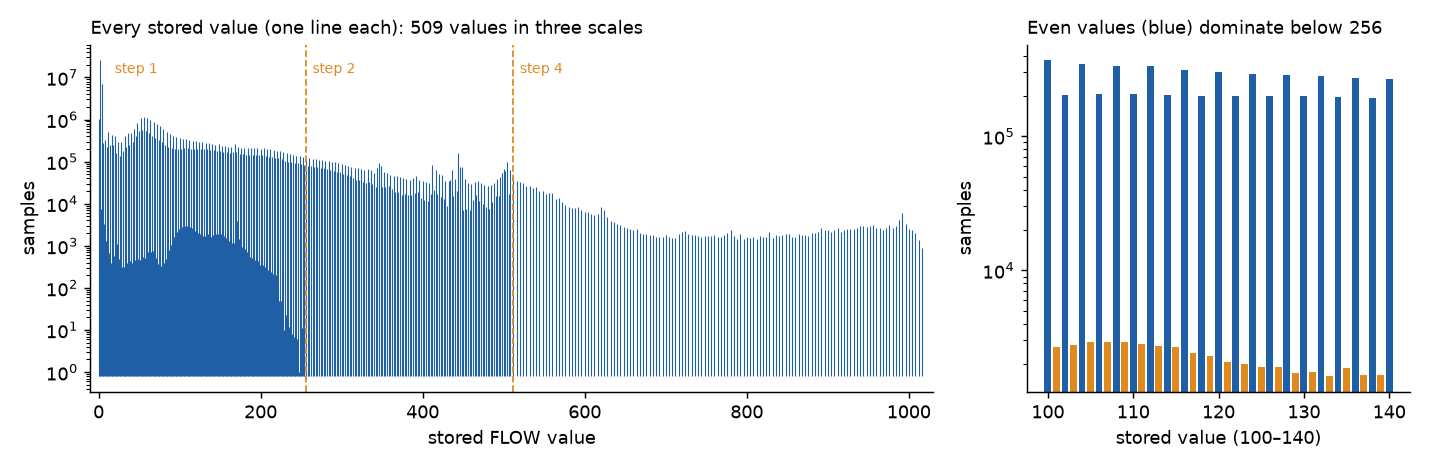
CardioQ FLOW uses three scales (a segmented code)
CardioQ FLOW values step by 1 from 0 to 255, by 2 from 256 to 510 and by 4 from 512 to 1016: 509 values, a 9-bit code whose step doubles in each upper segment, as in µ-law and A-law companding or a small floating-point format (an exponent and a 7-bit mantissa). Below 256, even values outnumber odd ones by 40 to 230 times.
| Status | likely: consistent, with a known gap. |
| Devices | CardioQ |
What it means
The resolution depends on the value, so each sample's quantisation uncertainty does too: step 1 below 256, 2 from 256, 4 from 512 (1 SD = step/√12: 0.29, 0.58 and 1.15 units). Below 256 the even-value comb makes the effective step mostly 2 (1 SD 0.58). A per-sample uncertainty model must take the step from the value, not one step per track.
What is done about it
Not modelled yet. The FLOW unit and the device's encoding are not documented in the release; the Deltex interface specification would settle both.
Evidence
| Study | Date | Status | Summary |
|---|---|---|---|
| Value resolution of every signal | 2026-10-19 | draft | How finely every waveform and numeric track in the release records its values. The SNUADC waveforms are 10-bit codes, though VitalRecorder's documentation describes the SNUADC as 12-bit; Primus waveforms use about 10 bits of 12; BIS EEG is a 16-bit grid of 0.05 µV. Numerics are 32-bit floats on decimal grids of 1, 0.1, 0.01 or 0.001, one per track; settings sit on coarser grids of 10 or 100. |
Figures