What the lab timestamp marks
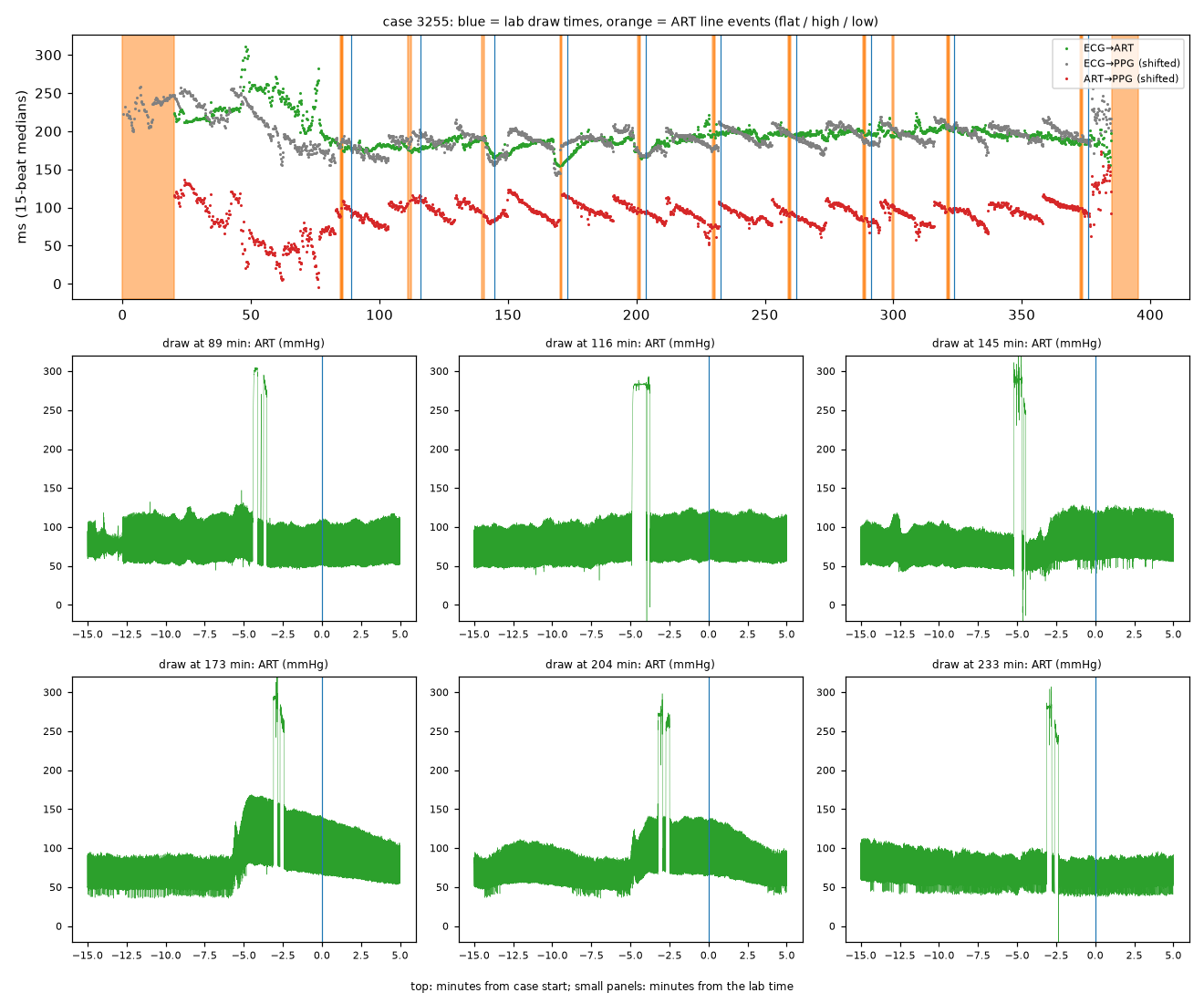
VitalDB's lab time is a per-specimen timestamp: not the draw, and not the result. Blood gases are stamped 3–12 minutes after the draw, central-lab panels about 8–24 minutes after it, and the result follows a turnaround the release does not record.
| Date | 2026-10-13 |
| Status | current |
| Methods | Clinical and laboratory times, Rounding, heaping and value resolution |
| Techniques | Null controls |
| Clocks | Hospital records clock |
| Devices | Clinical records, SNUADC |
| Variables | Blood gas result time, Central lab result time, Arterial pressure (SNUADC) |
| Supersedes | What lab timestamps mark |
Background
Until 13 October the lab time was treated as the result time, so a lab value counted as known at its timestamp. If it marks something earlier than the result, any model that uses a lab value at its timestamp sees the future.
Lab times are machine timestamps at 1 s resolution: the seconds are spread evenly (about 1.7% each) and there is no rounding to model. The question is only what event they mark.
Data
lab_data.csv: 131,942 case-timestamp pairs.- 1,440 cases with arterial pressure, for the check against the draw.
- For the panel comparisons: intra-operative central-lab panels (up to 30 min after anaesthesia end) with a blood gas in the hour before: CBC 1,665, coagulation 1,539, chemistry 1,613.
Method
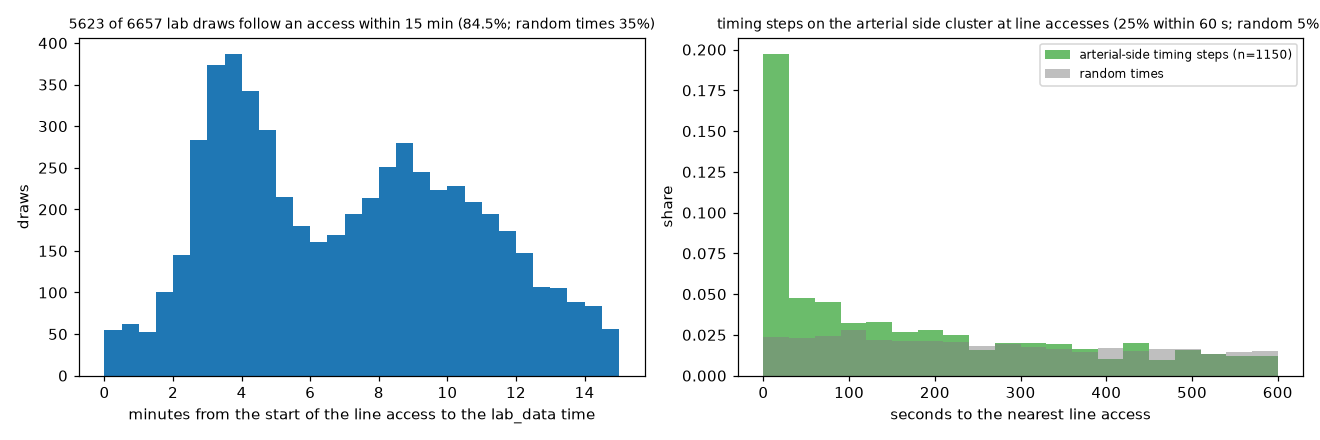
From the timestamps alone: whether all analytes of a panel share one time, how panels from one draw are spaced and in what order, how long after a point-of-care blood gas the central-lab panels are stamped, when in the day ward samples fall, and whether the minute of the hour heaps. From the draw: each group of lab samples matched to the latest arterial line access before it (within 15 minutes for blood gases, 30 for other panels), against the same lab times shifted 40–80 minutes as the control.
Results
- One timestamp per specimen: every analyte of a panel shares it to the second.
- Not the result time: panels run on different analysers from one draw are stamped seconds apart (75% of CBC–chemistry pairs within 60 s), centred on zero, and each panel is equally likely to come first. A result time would put chemistry consistently later.
- After a blood gas, central-lab panels are stamped a median of about 10 min later (a quarter within 5 min, three-quarters within 15), the same for CBC, coagulation and chemistry.
- Time of day and minute: ward CBCs peak at 08:00–09:00, after the early-morning phlebotomy round; the minute of the hour varies smoothly, with no spikes at 0 or 5.
- Not the draw time:
| Panel | Sample groups | Matched to an access | Lag from the access start to the timestamp | Above chance |
|---|---|---|---|---|
| Blood gas | 5,888 | 4,742 (81%) | p10 3.2 / median 7.2 / p90 12.2 min; modes at 2–6 and 8–12 min | 76% |
| Central lab | 1,837 | 618 (34%) | excess at 8–18 min, median about 14 min | 23% (weak) |
| Parameter | Value | Status | From |
|---|---|---|---|
| Blood gas timestamp after the draw | 7.2 min (p10–p90 3.2 to 12.2; two modes, 2–6 and 8–12 min) | measured | What the lab timestamp marks |
| Central lab timestamp after the draw | about 8–24 min (median about 14; weak, mostly chance matches) | estimated | What the lab timestamp marks |
Discussion
Central-lab timestamps mark the specimen reaching or being registered at the lab: the 10 minutes after a blood gas and the 8–18 minutes after a line access are the same transport delay seen from two starting points. Blood gases seem to take two routes: a point-of-care analyser in theatre (about 4 minutes after the draw) and samples sent on (about 9 minutes).
An earlier write-up from the resolution work (now merged here) put the blood-gas lag at "a few minutes at most". The access matching measures it directly, and its figures stand: 3–12 minutes.
Place a lab value no earlier than its timestamp plus an assumed turnaround; treat the draw as 3–12 minutes (blood gas) or roughly 8–30 minutes (central lab) before it. For the value side, lab times have a single resolution (1 s, anchor floor). The lab_time labels now carry available_at = lab_time_plus_turnaround, and earlier work that used lab values at their timestamp should be treated as possibly leaky.
Observations it supports
| Observation | Status | Summary |
|---|---|---|
| The lab time is neither the draw nor the result | established | VitalDB's lab timestamp marks the specimen (logged at the lab, or entered from a theatre analyser): minutes after the draw and before the result, whose time is not recorded. |
Limitations
Central-lab matches are mostly chance (many central samples are not drawn from the arterial line), so their lag is an estimate. The blood-gas-to-panel lag assumes the gas and the tubes are often drawn together. Result times are not in the release, so turnaround cannot be measured.
Open questions
- A firmer central-lab lag (next step). Most central-lab samples are not drawn from the arterial line, so their access matches are mostly chance and their lag is only an estimate.
- Turnaround after the timestamp (untestable assumption). The release has no result times, so the turnaround from the lab timestamp to the result is assumed, not measured.
Worked examples
| Example | Side | Status | Summary |
|---|---|---|---|
| End-tidal to arterial CO₂, and pulse oximetry against blood gas, at the right moment | time | draft | For 4,281 blood gases, reading the monitor when the blood was drawn rather than at the lab stamp makes changes in end-tidal CO₂ track changes in arterial CO₂ far better (within-patient correlation 0.74 against 0.54), and agreement peaks exactly at the estimated draw. Oximetry shows the same timing (agreement peaks at the draw), but the 100% ceiling hides the size of the oximetry gradient for three gases in four. |
Code
Figures