Draft
Worked through on a few cases; numbers may change.
Post-induction hypotension, from the charted start and from the devices
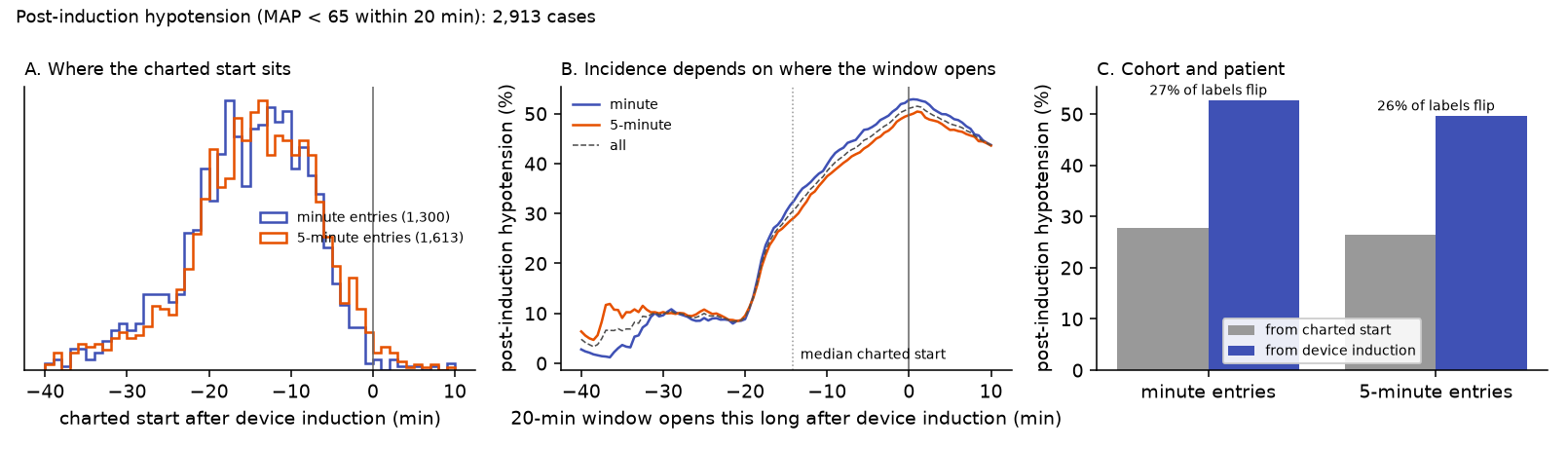
The charted anaesthesia start comes a median 14 minutes before the patient is induced; measured from it, "hypotension within 20 minutes of induction" is found in 27% of 2,913 patients, against 51% from the devices' induction, and the label changes for a quarter of patients.
| Side | time |
| Status | draft |
| Variables | Anaesthesia record events, BIS index, Infusion pump rates and volumes, Non-invasive blood pressure, Solar8000 ART and CVP numerics |
| Studies | Anaesthesia record times are rounded up |
The question
How many patients have a mean arterial pressure below 65 mmHg in the first 20 minutes after induction, and does it matter which time is taken as induction?
Inputs
Each input links to its measurement page: how it is timed, how its value was recorded, and how uncertain both are.
| Input | Unit | What it is |
|---|---|---|
| Anaesthesia record events | Anaesthesia and operation start and end times in the clinical table. Anaesthesia start marks the start of anaesthesia care, a median 14 minutes before device-marked induction (Post-induction hypotension, from the charted start and from the devices). | |
| BIS index | The BIS depth-of-anaesthesia index, computed from a window of EEG. | |
| Infusion pump rates and volumes | Drug infusion rates and volumes from the pumps. | |
| Non-invasive blood pressure | mmHg | Cuff blood pressure, recorded after each cuff cycle. |
| Solar8000 ART and CVP numerics | mmHg | Arterial and central venous pressure values from the Solar8000 monitor. |
Why the atlas changes the answer
Post-induction hypotension is a common outcome, usually counted from the charted anaesthesia start. Anaesthesia start entered on a 5-minute mark is rounded up (Anaesthesia record times are rounded up), about 2½ minutes late; but before that is the question of what the charted time stands for. The devices mark induction themselves: the BIS falls below 60 as the patient loses consciousness, and the propofol pump starts.
Data
2,913 cases with a device induction within −20 to +40 minutes of the charted start (88% from the BIS, the rest from the propofol pump), a recovered case clock, and blood pressure monitored in both windows (at least two cuff readings, or an arterial line running from the window's start); half have an arterial line.
Steps
- Device induction (Anaesthesia record times are rounded up,
tools/emr_markers.py): BIS below 60 held 30 s after BIS of 80 or more, else the first propofol pump rate. - Low pressure: a cuff reading below 65, or the arterial numeric below 65 for a minute or more.
- Hypotension within 20 minutes from the charted start, and from the device induction; cases split into 5-minute and minute entries by the recovered case clock.
- A sweep of the 20-minute window's start from 40 minutes before to 10 minutes after the device induction.
Results
The charted start is not induction. The device induction comes a median 14 minutes after the charted start (10th–90th percentile 6 to 25 minutes), in 5-minute entries and minute entries alike. The 2½-minute rounding is small next to this: the charted time marks the start of anaesthesia care, not the induction.
The cohort's incidence nearly halves.
| Window from | All (2,913) | 5-minute entries (1,613) | Minute entries (1,300) |
|---|---|---|---|
| Charted start | 27.1% | 26.5% | 27.8% |
| Device induction | 51.1% | 49.7% | 52.8% |
| Difference (95% interval) | +24.0 points (22.4 to 25.6) | +23.3 | +25.0 |
Moving the window's start shows why: the incidence peaks when the window opens at induction, and falls steeply as it opens earlier and covers the minutes before induction, when pressure is rarely low.
Per patient, a quarter of labels change (26%): 734 patients hypotensive from the device induction are not from the charted start, and 34 the other way. Where both windows find a low reading, it comes a median 4.1 minutes after the device induction, and 13.8 minutes after the charted start.
Population and individual
Systematic: does not cancel.
| The cohort | The incidence is 27% from the charted start and 51% from the device induction: the shift goes the same way in every patient, so it does not cancel. |
| Each patient | 26% of patients change label, nearly all from "no hypotension" to "hypotension". |
Takeaways
- Do not take the charted anaesthesia start as induction in VitalDB: it comes a median 14 minutes before it. Find induction from the devices (BIS, the propofol pump, the start of ventilation).
- A systematic shift in an event time moves a cohort's estimate as much as each patient's label: unlike rounding, it does not average out.
- Report which time a "post-induction" window starts from.
Limitations
- Device induction is BIS loss of consciousness in most cases; it comes after the induction drugs are given, so the true induction is a little earlier still. Cases without a BIS or a pump are left out.
- Cuff readings are sparse before the arterial line is placed; a short dip between readings is missed in both windows alike.
- Monitoring had to cover both windows, which selects cases.
Studies it relies on
| Study | Date | Status | Summary |
|---|---|---|---|
| Anaesthesia record times are rounded up | 2026-10-12 | current | Anaesthesia start and end entered on a 5-minute mark sit 90–290 s later, against device markers, than entries typed to the minute. Rounding up to the next 5 minutes fits every one of 11 markers better than rounding to the nearest or down. |
Reproduce it
bash examples/run_scan.sh induction_hypotension        # 8 parallel parts, about 10 minutes
python examples/induction_hypotension.py agg <work>/examples/induction_hypotension/part_*.jsonl --root <VitalDB release> --out out/induction